
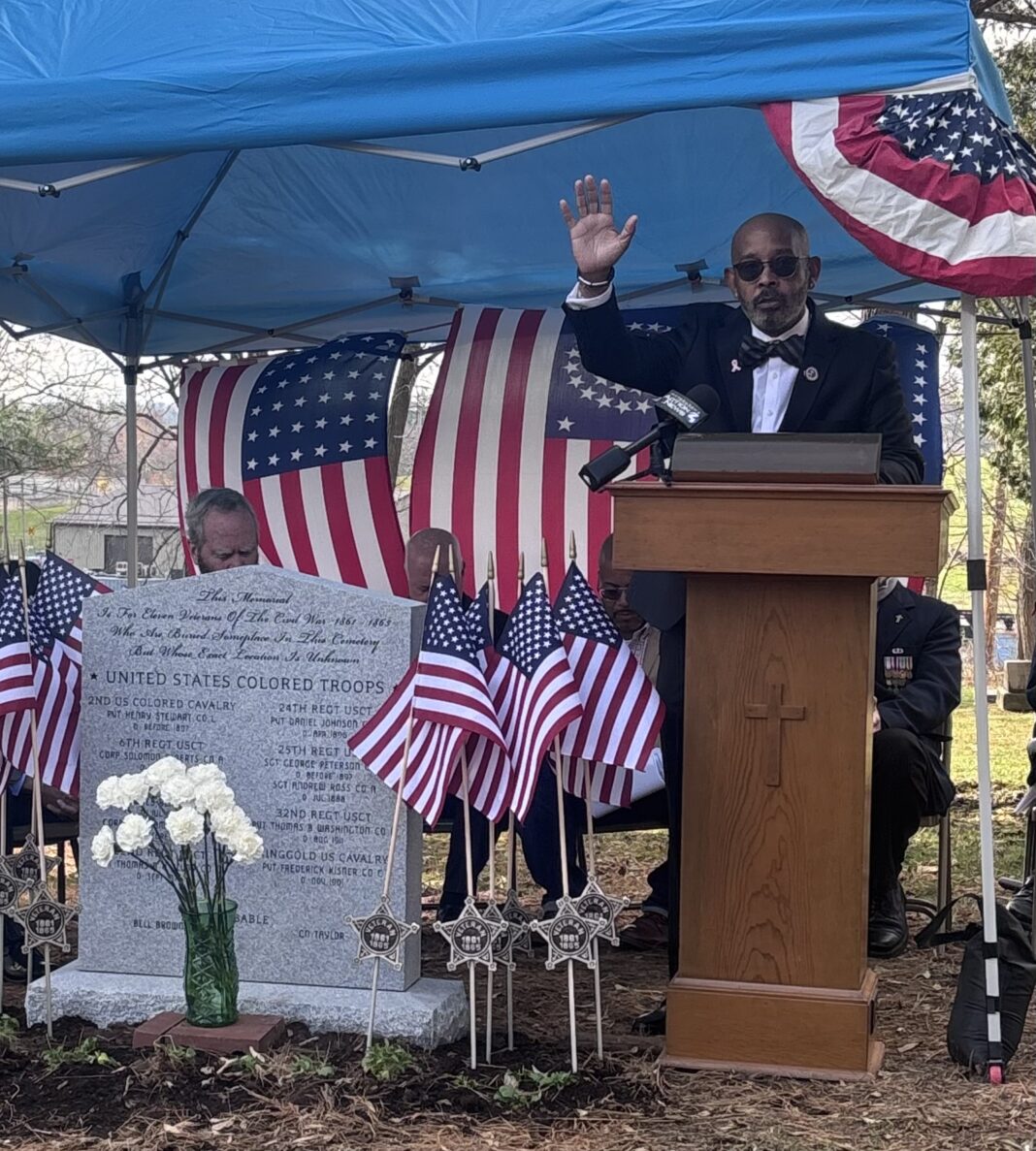


UNITED STATES COLORED TROOPS THAT WERE FORGOTTEN WERE FINALLY REMEMBERED IN A NOVEMBER 8, 2025, CEREMONY IN CANONSBURG. (PHOTOS BY MICHAEL WALSH)
by Michael Walsh
For New Pittsburgh Courier
On Saturday, Nov. 8, 2025, just after noon in the graveyard at the Payne African Methodist Episcopal Church in Canonsburg, Pa., a drum cadence rang out into the unseasonably clear and warm day. This signaled the beginning of the “Forgotten Valor: The Union Veterans Stone Dedication Ceremony,” where a new headstone would memorialize 13 veterans who are interred there, all of whom served as United States Colored Troops in the Civil War over 150 years ago.
The attendees from Canonsburg and beyond listened as leaders from the African Methodist Episcopal Church, NAACP and local government spoke alongside leaders of the Sons of Union Veterans of the Civil War organization, who organized the event alongside members of the Payne AME Church.
The veterans, all buried between 1875 and 1911, have had their graves lost to time, with the only known detail being that they are interred somewhere in the grounds of the church’s cemetery. Despite that loss, they were remembered by the congregation at Payne AME, which was connected to Fredric Bender, Sons of Union Veterans of the Civil War Vice Commander of Camp 120, representing parts of Southwestern Pa. in 2022.
After discussions between congregation leaders and members of the Sons of Union Veterans of the Civil War, it was found that their list of 17 Civil War veterans buried at Payne AME was incomplete, as the congregation’s own records revealed an additional 13, totaling 30 veterans buried at the cemetery.
Once these veterans were rediscovered by Bender’s organization, he embarked on a journey with regional genealogist, researcher and author in Black history Hazel Murray in illuminating the forgotten story of the 13 veterans who are buried at the cemetery. After years of work, they completed their collective research, titled “Forgotten Valor: The USCT of Payne Chapel, Canonsburg, Pa.” Their work details the lives and battles of the 13 veterans who, for the most part, had been forgotten, except for a few mentions in decades-old records.
Some of the 13 veterans rediscovered were: Private Henry Stewart, Private Solomon Alberts, Private James Banks, Private James Black, Corporal Abraham, Lewis Private Thomas B. H. Sluby, Private Daniel Johnson, Sergeant George Peterson, Sergeant Andrew Ross, Private Thomas B. Washington, and Private Fredrick Kisner. They are all listed in available church, federal and local records as service in the U.S. Civil War and passing between 1875 and 1911 in Canonsburg.
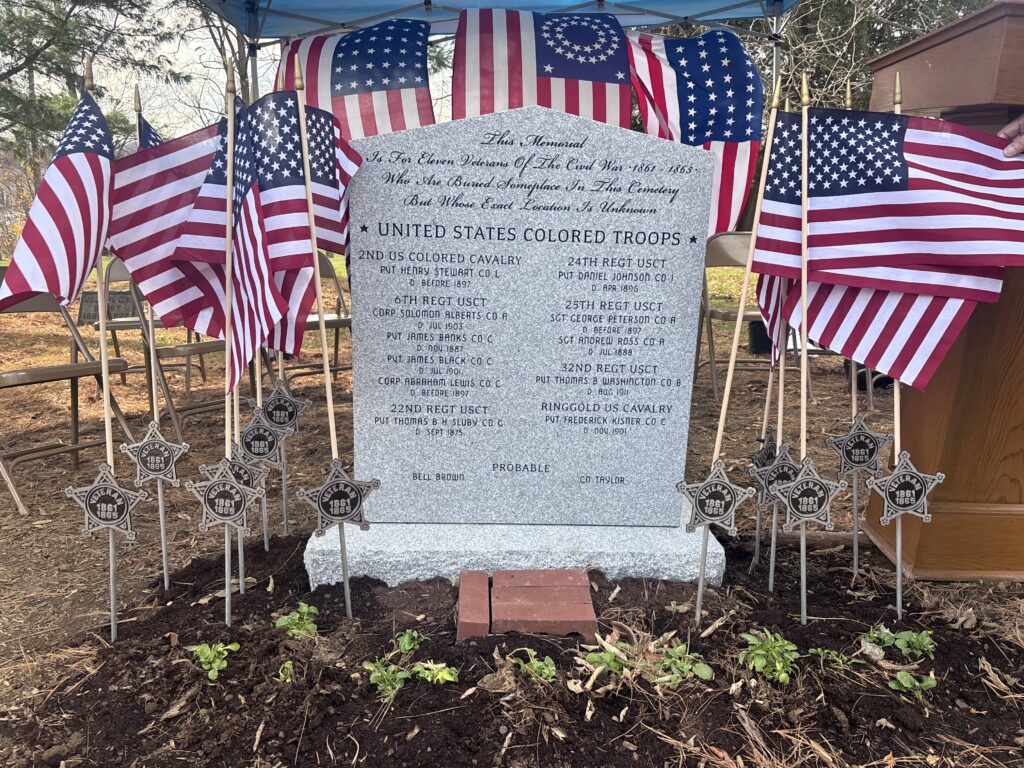
Almost all the men served as United States Colored Troops, segregated from their fellow White soldiers but who fought no less bravely until the end of the war, which, according to Bender and Murray’s research, was as close to home as Romney, West Virginia, only two hours from Pittsburgh, or as far as the Outer Banks in the Carolinas, or Brownsville, Texas. One soldier, Private Kisner, did serve among White troops in the local Ringgold Calvary, a volunteer unit raised independently in Washington, Pa.
During the ceremony, prayers and a scripture reading by Rev. Marilyn S. Fisher set the tone of the event, reminding those gathered that the ground they trod is filled with sacrifice relating this to the Gospel of John, 15:13, which states that there is no “Greater love than this: to lay down one’s life for one’s friends,” which paralleled the service of the veterans and their sacrifice in war to laying down a part of themselves and their lives, as free men.
After these prayers and the Pledge of Allegiance, two members of the Sons of Union Veterans of the Civil War unveiled the stone, a large, light grey granite marker inscribed with the names, ranks, units and approximate years of passing of the veterans. To remember them, each veteran’s name was called by Canonsburg Councilman Eric Chandler, followed by several distinguished speakers walking to the marker and placing a white rose and an American flag.
As the ceremony concluded, Bender, who through his research, his book and the event reflected, “This may be the greatest honor of my life.”
He added that ironically, after growing up in Canonsburg, he had never “known about the servicemen who laid here, as a kid and until recently I just did not know.”
The Presiding Elder of Payne AME had the final word of the day: “If you do not know your past, you cannot understand your present. If you cannot understand your present, you cannot improve your future… today, we honor the sacrifice of those who helped preserve a dis-united nation. Their courage is immeasurable.”