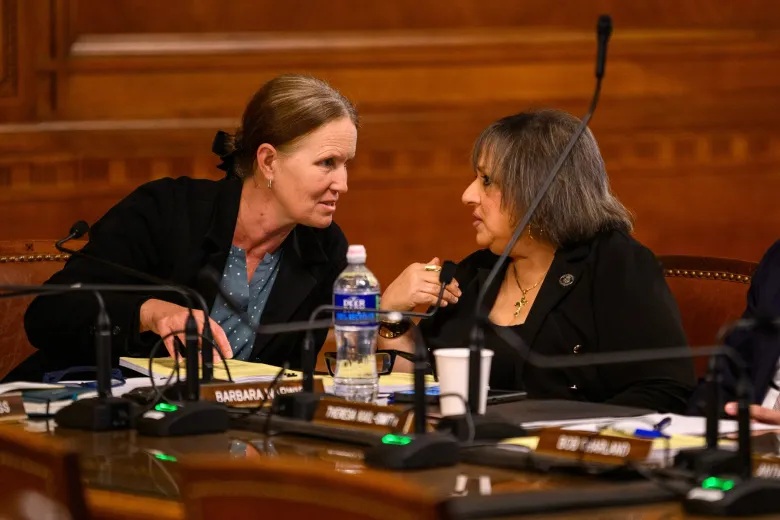


Pittsburgh City Council members Barb Warwick (left) and Theresa Kail-Smith talk at an Oct. 15, 2025 meeting.(Photo by Alex Jurkuta/Pittsburgh’s Public Source)
Councilor Barb Warwick introduced the tax increase bill. The public can comment at a Dec. 22 hearing.
“Pittsburgh’s Public Source is an independent nonprofit newsroom serving the Pittsburgh region. Sign up for our free newsletters.”
Pittsburgh City Council will consider legislation to raise the city’s property tax rate this month as lawmakers race to close major gaps in Mayor Ed Gainey’s budget proposal ahead of a Dec. 31 deadline.
Councilor Barb Warwick, a Greenfield Democrat, said in a press release Monday morning that she would introduce a bill to increase the city’s real estate tax by 30% in 2026.
That would raise the millage rate from 8.06 mills to 10.48. One mill is equal to $1 in tax for every $1,000 in assessed value.
Warwick said the proposal would cost the owner of a home valued at $100,000 an additional $20.17 per month, or $242 per year for those who pay annually.

“This is something no elected official wants to do, but it is the responsible thing to do,” Warwick said in a written statement. “Times are tough for everyone right now, but after 11 years without a tax increase, the city needs additional revenue in order to keep providing the core services that our residents deserve and depend on.”
The public can comment on the proposal at a Dec. 22 hearing, Warwick said. Council and the mayor have to agree on a balanced budget by the end of the year.
The budget and tax bills need approval from five of Council’s nine members to pass (six if Gainey uses his veto power). It’s unclear how many members support Warwick’s proposal; at least one, outgoing member Theresa Kail-Smith, said she opposes any tax hike.
Gainey’s press secretary Olga George said Monday afternoon that the mayor’s team would work with council to “ensure the final budget reflects our community’s priorities,” but did not say whether the mayor would sign Warwick’s bill if it passes.
George maintained that the administration proposed a balanced budget, “even though it includes some difficult choices.”

Mayor-elect Corey O’Connor, who will take office Jan. 5 and inherit the budget and tax rates that are passed this year, said Monday that he will “work with council to assess all options that allow us to maintain essential services … and eliminate spending in areas that the city simply cannot afford.”
O’Connor did not specifically say if he supports Warwick’s proposal.
Other council members did not immediately respond to requests for comment on the proposal — including Law and Finance Chair Erika Strassburger and Council President R. Daniel Lavelle.
On Tuesday council passed, without discussion or dissent, two non-binding resolutions related to the budget. One declares that Gainey’s proposal does not “adequately [serve] the needs of Pittsburgh residents” and asks the mayor and his staff to work with council to change it ahead of the deadline.
The other calls on the Allegheny County government to conduct a countywide property reassessment, a move some policymakers have long called for to stabilize municipal finances. The county last reassessed in 2012.
County government spokesperson Abigail Gardner said in response that a reassessment would be “revenue neutral for local governments, including both the City of Pittsburgh and Allegheny County. Additional revenue can only be generated for Pittsburgh by raising taxes.”
The county faces litigation seeking to force a reassessment. Advocates for tax fairness argue that a failure to reassess locks in inequities because people whose property values appreciate end up underpaying while others overpay.
Residents are already dealing with tax hikes elsewhere. Allegheny County raised its millage rate 36% effective this year and Pittsburgh Public Schools is considering an 4% increase of its own ahead of 2026, with a budget briefing set for tonight.
Editor’s note (12/9): This story was updated with information on the Tuesday passage of non-binding resolutions by City Council.
Charlie Wolfson is the local government reporter for Pittsburgh’s Public Source. He can be reached at charlie@publicsource.org.
This article first appeared on Pittsburgh’s Public Source and is republished here under a Creative Commons Attribution-NoDerivatives 4.0 International License.
PARSELY = { autotrack: false, onload: function() { PARSELY.beacon.trackPageView({ url: “https://www.publicsource.org/pittsburgh-city-council-property-tax-hike-2026/”, urlref: window.location.href }); } }