
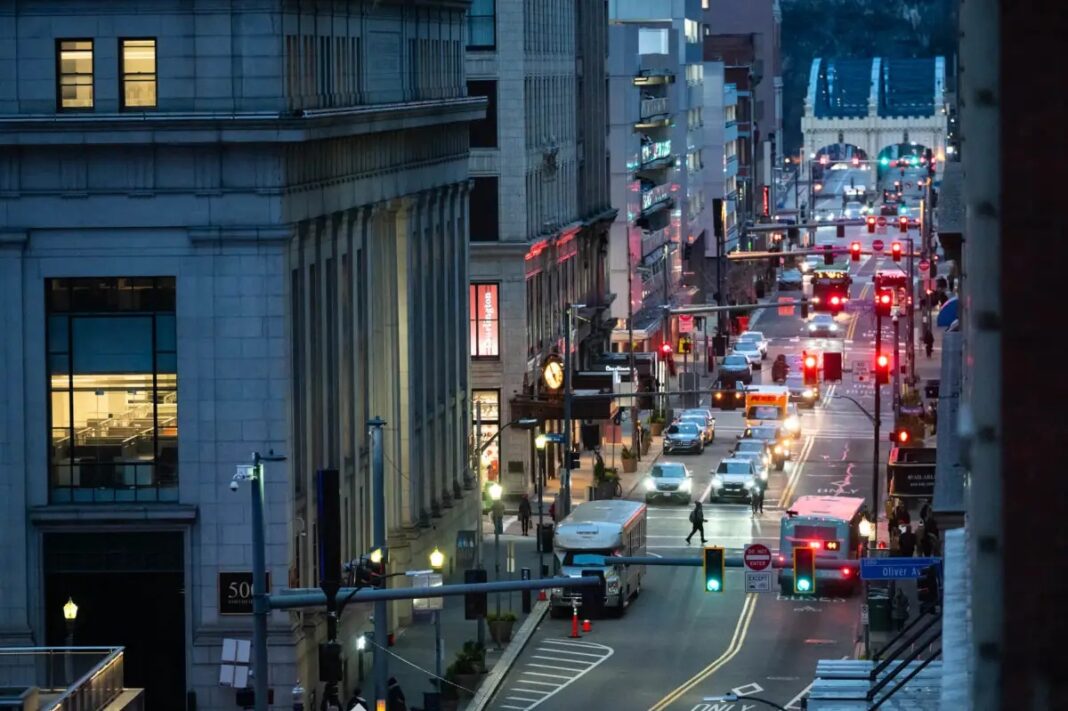


Pedestrians and drivers make their way along Smithfield Street between Oliver Avenue and the Smithfield Street Bridge on Wednesday, Dec. 4, 2024. (Photo by Stephanie Strasburg/PublicSource)
The Urban Redevelopment Authority board authorized a study that could draw on future property tax revenue from three neighborhoods to finance Downtown improvements.
“Pittsburgh’s Public Source is an independent nonprofit newsroom serving the Pittsburgh region. Sign up for our free newsletters.”
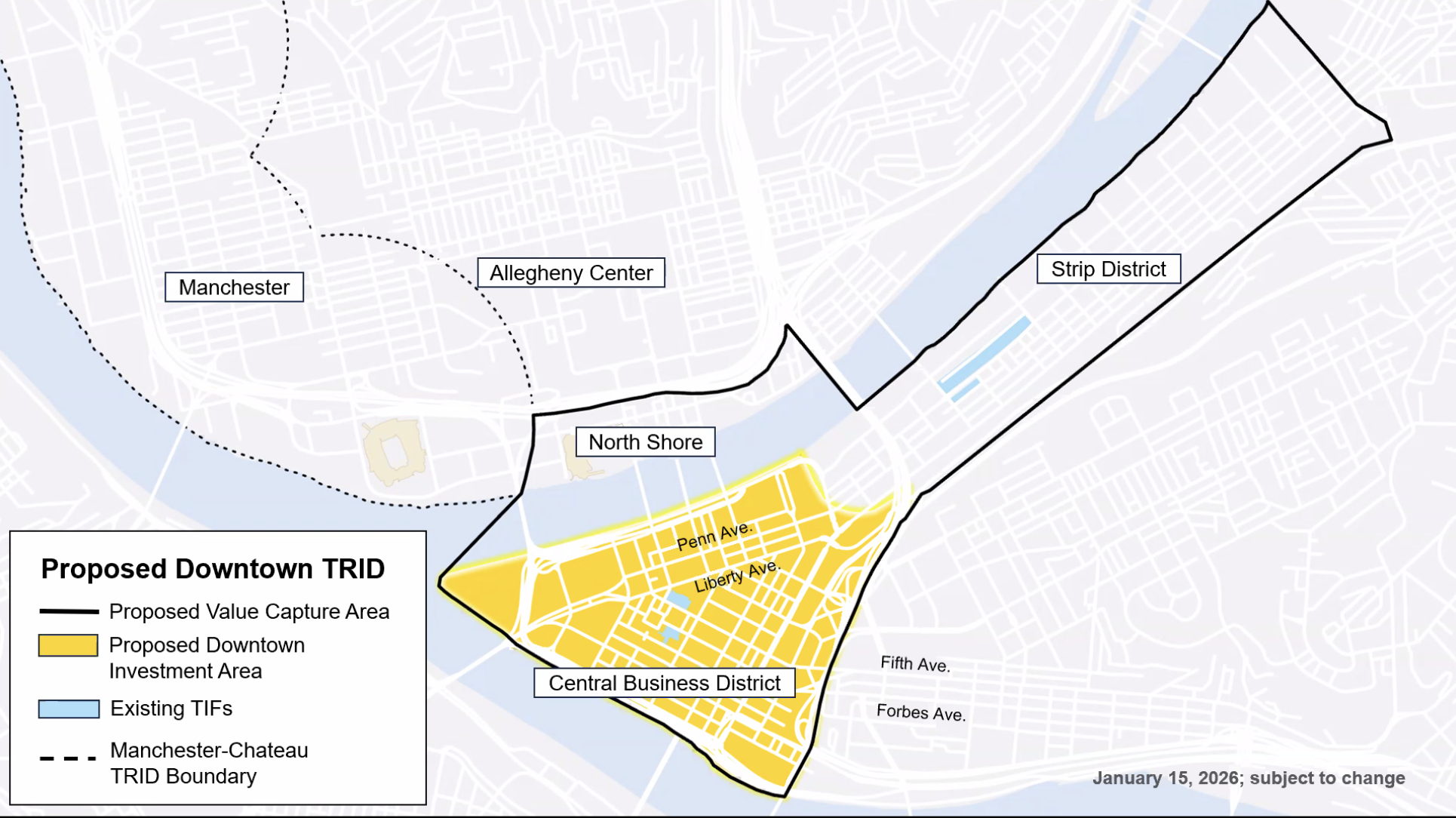
Pittsburgh’s Urban Redevelopment Authority (URA) board voted today to start a process which could turn long-term property tax revenue raised in Downtown, the Strip District and part of the North Shore into investments in the Golden Triangle.
The board meeting was the first during Mayor Corey O’Connor’s administration, and saw the return of Yarone Zober as chair — a role he served during Mayor Luke Ravenstahl’s administration. He’s now O’Connor’s director of redevelopment. Also joining the board is Pittsburgh City Councilor Bob Charland.
URA staff told the newly constituted board that a next step in reviving Downtown is the creation of a Transit Revitalization Investment District. The TRID would be a partnership between the URA, city, Allegheny County, Pittsburgh Public Schools and Pittsburgh Regional Transit (PRT).
The TRID would not cut into taxes paid on currently existing buildings. But for development occurring in the future, a percentage of the new tax revenue would be diverted into the TRID fund, for years or decades. Because of that pledge, the URA could borrow money in the near term and spend it. The borrowing would be paid off over time, using the set-aside revenue.
The borrowed money could pay for:
- Transit-oriented development that builds on the emerging PRT rapid transit line from Downtown to Oakland
- Public realm improvements
- Real estate investments
- Infrastructure improvements
- Professional services consultants needed to create the TRID and float the bond.
Generally, TRID dollars would provide the seed money needed to start a project, or the final funds needed to complete a financing plan.
The dollars to be generated by the TRID are yet to be determined. The board’s vote allows URA staff to engage the consultants and start a public process that could last a year.
The board vote sets the TRID map. While taxes for the improvements would flow from three neighborhoods, the plan is to spend the borrowed money Downtown.
URA board member Lindsay Powell, a state representative, D-Lawrenceville, whose district includes the Strip, questioned the plan’s all-for-Downtown emphasis.
“I think this opens up a lot of opportunities,” Powell said, citing riverfront transit, trails and housing investments as potential uses. “Obviously if Downtown does well, then all of Pittsburgh, all of our neighborhoods do well. … I just don’t want all of the value to go to one” area.
Board member Sam Williamson echoed the possibility that some of the funds raised could go to the Strip.
Zober emphasized that the vote to study the TRID “is the first step in a very, very long journey on every front.” URA staff will bring a fleshed-out plan to the board for a vote at a later date. City and county councils and the school board would also vote.
Staff said the push for a TRID is in part due to the lack of available federal funds.
Rich Lord is Pittsburgh Public Source’s managing editor and can be reached at rich@publicsource.org.
This article first appeared on Pittsburgh’s Public Source and is republished here under a Creative Commons Attribution-NoDerivatives 4.0 International License.