
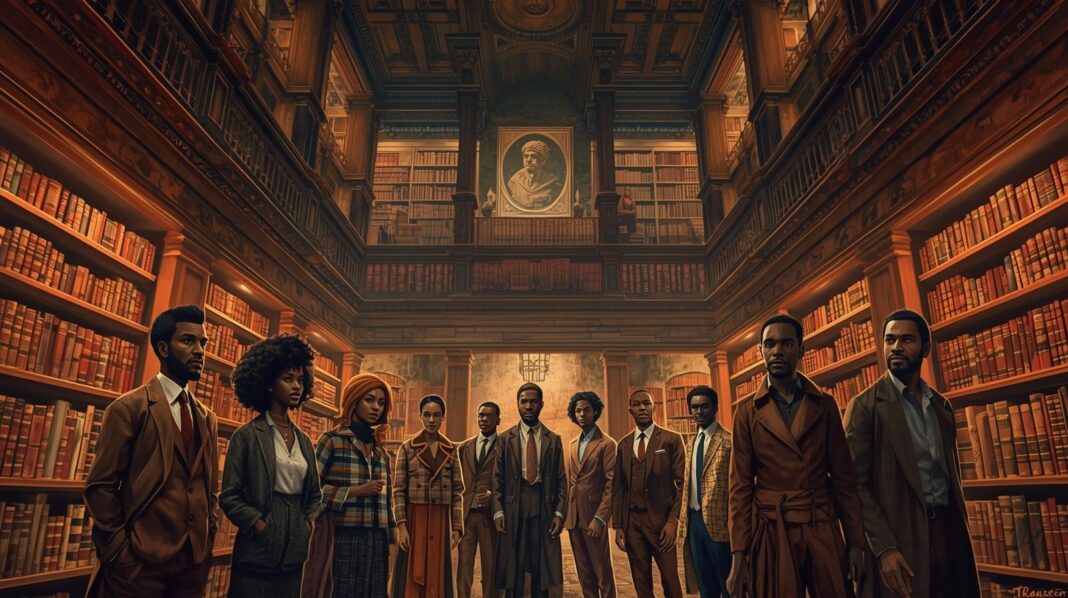


An image depicting Blacks, who have joined the ancestor, each representing a library of knowledge and wisdom now gone too soon. (Created using AI-SGF)
by Stephanie Gadlin, For The Chicago Crusader
“When an elder dies, a library burns to the ground.” — African Proverb
This year-end retrospective honors African Americans who joined the ancestors in 2025, expanding the great cloud of witnesses that guides us still. While this accounting features notable figures such as civil rights warriors, entertainers, business pioneers, public servants and political trailblazers, we recognize every life who graced this earth, In Memoriam.
Though death takes away presence, their lives leave behind legacy, memory, instruction, and in African American culture, far too often the “unfinished tasks.” On Nov. 24, Viola Fletcher, died at the age of 111. She was the last survivor of the 1921 Tulsa Race Massacre. Fearless, loving, determined, Ms. Fletcher died without receiving the reparations she demanded before Congress when she was at the age of 107. Tulsa’s library did not burn and will not as long as the Black Press and those whom it speaks for remain to tell her story.
Too many have joined the ancestors this year—some after long lives, others stolen too soon—taking with them wisdom, courage, vision, and artistry we still desperately need. In the language of the Black prophetic tradition, we say they have ‘gone home’.”
We who remain must labor, carry their stories, demand their justice, finish their work, uphold, honor or cherish their names and most of all never forget. We are because they were.
The Crusader 2025 Ancestral Roll Call
JANUARY
Sam Moore, 89 (1935) was one half of soul duo Sam & Dave whose gospel-trained voice powered “Soul Man” and “Hold On, I’m Comin’,” earning Rock & Roll Hall of Fame induction in 1992. He died Jan. 10.
Gus “The Wizard” Williams, 71 (1951) was a two-time NBA All-Star who led the Seattle Supersonics to the 1979 championship with dazzling ball-handling. He died Jan. 15.
Earl H. Smith Jr., 90 (1934) was a four-time Hall of Famer, who was inducted into the Indiana Track & Field (1990), Indiana Football (2007), Indiana Basketball (2018), and Gary Sports (2023) Halls of Fame. Smith served 56 years with the Gary Community School Corporation as teacher, coach, dean, assistant principal, and citywide athletic director. As a multi-sport star at Gary Roosevelt High School, he set a state long jump record (23 feet, 2.5 inches) that stood for two decades, then earned All-Big Ten honors in football and track at the University of Iowa. The brother of the late State Sen. Earline Rogers and a member of Kappa Alpha Psi Fraternity, Inc., Smith was posthumously honored with the inaugural Earl H. Smith Award for Excellence in Leadership by the Gary Sports Hall of Fame in 2025. He died Jan. 16 in Gary.
DJ Unk (Anthony Platt), 43 (1981) was the Atlanta snap music pioneer whose “Walk It Out” became a 2006 anthem. He died Jan. 24.
FEBRUARY
Gene Barge, 98 (1926) was saxophonist, arranger, and producer known as “The Governor” who worked with Chuck Berry, Muddy Waters, and recorded the classic “Quarter to Three.” He shaped the Chicago blues and R&B sound for six decades. He died Feb. 2.
Lt. Col. Harry Stewart Jr., 100 (1924) was one of the last Tuskegee Airmen who downed three enemy aircraft in one day over Italy in 1945, earning the Distinguished Flying Cross. He died Feb. 2.
Irv Gotti (Irving Lorenzo Jr.), 54 (1970) founded Murder Inc. Records and shaped early 2000s hip-hop by pairing Ja Rule and Ashanti for platinum hits. He died Feb. 5.
Sam Nujoma, 95 (1929) was Namibia’s founding president who led his nation from apartheid South African occupation to independence in 1990. He died Feb. 8.
Chelsea Reject, 31 (1993) was Brooklyn lyricist known for gritty street narratives and underground battle rap prowess. He died Feb. 12, 2025, from a medical emergency.
Souleymane Cissé, 84 (1941) was pioneering Malian filmmaker whose Yeelen (1987) won the Jury Prize at Cannes and established African cinema on the world stage. His films explored colonialism, tradition, and modernity through distinctly African visual storytelling that rejected Western narrative conventions. He died Feb. 19.
Jerry “The Iceman” Butler, 85 (1939) rose from Mississippi sharecropper roots and Cabrini-Green to co-write “For Your Precious Love” with The Impressions, then crafted solo hits pioneering Philadelphia soul. Inspired by Mayor Harold Washington’s 1983 election, Butler served over 30 years on the Cook County Board of Commissioners, chairing Health and Hospitals and championing Stroger Hospital’s opening. He died Feb. 20.
Roberta Flack, 88 (1937) was the classically trained pianist who earned a Howard University scholarship at 15 and became the first artist to win consecutive Record of the Year Grammys for “The First Time Ever I Saw Your Face” and “Killing Me Softly With His Song.” She died Feb. 24.
Chris Jasper, 73 (1952) was a founding member of the Isley Brothers whose keyboard and songwriting powered hits like “Fight the Power” and “Between the Sheets.” He died Feb. 24.
MARCH
Angie Stone (Angela Laverne Brown), 63 (1961) was neo-soul pioneer and Grammy-nominated singer behind hits “Wish I Didn’t Miss You” and “No More Rain (In This Cloud).” She co-founded The Sequence in 1979, one of the first all-female hip-hop groups whose single “Funk You Up” became one of the most sampled songs in hip-hop history. Her 1999 debut album Black Diamond went gold, and her 2001 album Mahogany Soul cemented her as a cornerstone of the neo-soul movement. She wrote songs for D’Angelo’s Brown Sugar and Voodoo albums, and her 45-year career earned her induction into the Women Songwriters Hall of Fame in 2024. She died March 1, 2025, in a car crash on Interstate 65 in Alabama.
DJ Funk (Charles Chambers), 54 (1971) was the West Side native who pioneered Chicago House Music, creating “Work Dat Body” and influencing Daft Punk and Disclosure. He died March 5.
George Foreman, 76 (1949) was a two-time heavyweight boxing champion, 1968 Olympic gold medalist, ordained minister, and billionaire entrepreneur. He died March 21.
Sayso P, 27 (1997) was Memphis Street rap artist known for raw storytelling and authentic Southern hip-hop sound. He died Mar. 22, 2025, in a shooting.
Young Scooter (Kenneth Edward Bailey Jr.), 39 (1986) was Future’s cousin and Southern hip-hop artist. He died March 28 in a police pursuit crash in Atlanta on his birthday.
APRIL
Sam Pee Yalley was Ghanaian diplomat who represented Ghana’s interests internationally and fostered Pan-African diplomatic relations. He died Apr. 6.
Alexis Herman, 77 (1947) made history as the first African American U.S. Secretary of Labor under President Bill Clinton (1997-2001). Her career began fighting school desegregation in Mobile, Alabama, progressed through leading the Women’s Bureau at the Department of Labor, and culminated in Cabinet service where she understood labor rights as civil rights. She died April 25.
MAY
Charles B. Rangel, 94 (1930) represented Harlem in the U.S. House of Representatives for 23 terms (1971-2017), co-founded the Congressional Black Caucus, and became the first Black chairman of the House Ways and Means Committee. He died May 26.
Michael Sumler, 70 (1954) was keyboardist and arranger for Kool & The Gang who contributed to their signature funk and R&B sound across multiple decades. He died May 27, 2025, in a car accident.
JUNE
Edgar Chagwa Lungu, 68 (1956) was sixth president of Zambia (2015-2021) who succeeded Michael Sata and oversaw infrastructure development and constitutional reforms before losing the 2021 election to Hakainde Hichilema. After leaving office, he remained active in opposition politics, challenging restrictions on his political activities and advocating for democratic governance. He died June 5, 2025, in Pretoria, South Africa, at Mediclinic Medforum Hospital while undergoing treatment for cardiac complications.
Wayne Lewis, 68 (1957) was Atlantic Starr’s founding member whose voice powered “Always” and “Secret Lovers.” He died June 5.
Dr. Norman Hutchins, 62 (1962) was a gospel singer, pastor, and Grammy nominee whose “God’s Got A Blessing (With My Name On It)” propelled Christian music forward. He died June 5.
Renee Ferguson, 75 (1950) became the first African American woman investigative reporter in Chicago television at CBS Chicago (1977-1983), going undercover at Waller High School to expose conditions forcing administrative changes. She questioned celebrated educator Marva Collins’ methods when other reporters wouldn’t, then anchored NBC 5’s investigative unit until 2008. She died June 6.
Sylvester “Sly Stone” Stewart, 82 (1943) founded Sly and the Family Stone, blending gospel, soul, rock, funk, and psychedelia into a late 1960s sound promoting unity with hits like “Everyday People,” “Family Affair,” “If You Want Me to Stay,” “Thank You (Falettinme Be Mice Elf Again)” and “Dance to the Music.” He had massive influence on thousands of recording artists and is the founder of the “progressive soul” movement. In 2017 he was awarded a Grammy Lifetime Achievement Award. He died June 9 and three months later was inducted into the Rhythm and Blues Hall of Fame posthumously.
Ananda Lewis, 52 (1973) was the MTV VJ and talk show host who made Total Request Live and The Ananda Lewis Show feel personal. She died June 11 after a five-year breast cancer battle.
Calvin “Omar” Johnson, 67 (1958) was born in Mississippi’s Coila community and became the West Side’s militant general who shut down the Stevenson Expressway in 2000 with his Work-Ship Coalition, demanding Black workers receive construction contracts. He died June 16.
Lynn Hamilton, 95 (1930) was the Yazoo City, Mississippi native who portrayed Donna Harris on “Sanford and Son,” bringing dignity to Black womanhood across a 50-year career. She died June 19.
Walter Scott, 81 (1943) co-founded The Whispers with twin brother Wallace, crafting silky R&B hits earning five gold albums, two platinum albums, and Vocal Group Hall of Fame induction. He died June 26.
JULY
Mosie “Mama” Burks, 92 (1933) was Mississippi Mass Choir lead vocalist whose voice on “They Got the Word” and “I’m Not Tired Yet” defined the choir’s global sound. She died July 7.
Muhammadu Buhari, 82 (1942) served as Nigeria’s former president (2015-2023). He died July 13 in London after prolonged illness.
Robbie Pardlo, 46 (1978) was City High member whose voice powered “What Would You Do?” and “Caramel.” He died July 19.
Malcolm-Jamal Warner, 54 (1970) transcended his role as Theodore “Theo” Huxtable on “The Cosby Show” to become a Grammy-winning spoken-word poet, television director, and jazz musician. His portrayal of Theo redefined positive Black family representations on 1980s television, showing that Black teenagers deserved patience and unconditional love. He died July 20 in an accidental drowning in Costa Rica.
AUGUST
Rahaman Ali (Rudolph Arnett Clay), 82 (1943) was Muhammad Ali’s younger brother who followed him into boxing (1964-1972, record 14-3-1) and spent his life as Muhammad’s sparring partner, corner man, and chronicler. He died Aug. 1.
Dr. Edward Omane Boamah (1970s) was Ghanaian government minister who served his nation’s development and governance initiatives. He died Aug. 6, 2025, in a helicopter crash.
Dr. Ibrahim Murtala Muhammed (1970s) was Ghanaian government minister who died alongside Dr. Boamah serving their country. He died Aug. 6, 2025, in a helicopter crash.
Danielle Spencer, 60 (1965) played Dee Thomas on “What’s Happening!!” and later became a veterinarian. She died Aug. 11.
Vivian Ayers Allen, 102 (1923) was a poet, Rice University’s first African American faculty member, and mother of Debbie Allen and Phylicia Rashad. She died Aug. 18.
Brandon “Wam SpinThaBin” Wamley, 25 (1999) was Florida rapper and member of Kodak Black’s Sniper Gang collective known for drill-influenced Southern rap. He died on August 28, 2025, in a Florida shooting.
Dr. Clayton C. Stansbury Jr., 93 (1932) was an educator and Morgan State University counselor who served as dean of the Honors College. He died Aug. 30.
SEPTEMBER
Demartravion “Trey” Reed, 21 (2004) was found hanging from a tree on Delta State University campus in Cleveland, Miss., 35 miles from where Emmett Till was lynched. Officials ruled it suicide, but activists uncovered troubling evidence: Reed had defended a Black female student online against white supremacist attacks days before; he was found with a belt three times his size in the only campus area without cameras; his cell phone was missing yet GPS showed it moving post-mortem. A second autopsy funded by Colin Kaepernick was reportedly inconclusive but revealed details that raise doubt on the official findings. He died Sept. 18.
Ron Carroll, 56 (1968) was Chicago house music producer and DJ whose deep, soulful sound helped define the second wave of house music globally. He died Sept. 21, 2025.
Assata Shakur, 78 (1947) was a Black Panther Party and Black Liberation Army member who fought white supremacy and state violence in the early 1970s. Convicted in 1977 of killing a New Jersey state trooper under circumstances supporters called politically motivated, she escaped prison in 1979 and received political asylum in Cuba in 1984, where she lived 41 years as both freedom fighter icon and fugitive symbol. She died Sept. 25.
Vanessa Brown Knowles, 63 (1962) was The Brown Singers founding member whose gospel voice filled churches. She died Sept. 28.
OCTOBER
Arthur Jones, 39 (1986) was a Baltimore Ravens defensive lineman who helped win Super Bowl XLVII. He died Oct. 3.
Kimberly Hébert Gregory, 52 (1972) was an actress celebrated for “Vice Principals” and “Kevin (Probably) Saves the World.” She died Oct. 3.
Ike Turner Jr., 67 (1958) was a Grammy-winning musician and son of Ike and Tina Turner who contributed to “Risin’ With the Blues.” He died Oct. 4.
Dr. Paulette C. Walker, 77 (1948) was Delta Sigma Theta’s 25th national president (2013-2017) and educational leader. She died Oct. 8.
D’Angelo (Michael Eugene Archer), 51 (1974) was the neo-soul architect whose albums “Brown Sugar,” “Voodoo,” and “Black Messiah” redefined Black music’s possibilities. He died Oct. 14.
Joseph Caldwell Sr., 92 (1933) was the Arkansas native who moved to Chicago at 16, served in the Air Force during the Korean War, and opened TailoRite Complete Clothing at 79th Street in 1956. When major banks refused capital, Black-owned Seaway Bank financed the shop that served Harold Washington, Jesse Jackson, and White Sox players for 69 years. He died Oct. 14.
Nana Konadu Agyeman-Rawlings, 76 (1948) was former First Lady of Ghana and founder of the 31st December Women’s Movement who championed women’s economic empowerment and political participation across Africa. She ran for president in 2016, advocating for Pan-African unity and women’s leadership. She died Oct. 23.
Sherard “Posta Boy” Dixon, 42 (1982) was battle rap and freestyle artist who earned respect in New York’s underground hip-hop circles for his sharp wordplay and competitive spirit. He died on October 27, 2025, after a battle with cancer.
NOVEMBER
Glenn “Young Bleed” Clifton Jr., 51 (1974) was Baton Rouge rapper and No Limit Records artist known for his distinctive Louisiana drawl and the hit “How Ya Do Dat” featuring Master P. His 1998 debut album “My Balls and My Word” went gold and reached the Top 10 of the Billboard 200. He died November 1 from a brain aneurysm after collapsing at an afterparty following his performance at the Cash Money Verzuz No Limit event in Las Vegas.
Jamil Abdullah Al-Amin, born Hubert Gerald Brown, 82 (1943) was the Student Nonviolent Coordinating Committee chairman who rose to prominence in the late 1960s as Black Power’s most radical voice, declaring “violence is as American as cherry pie.” He became known as H. Rap Brown. After SNCC and the Black Panther Party, he converted to Islam, became an Atlanta imam, and was convicted in 2002 of killing Fulton County Deputy Ricky Kinchen—a case he and supporters called a frame-up. He died Nov. 23 in federal prison, maintaining innocence.
Phil Upchurch, 86 (1939) was the Chicago guitarist whose career left fingerprints on Donny Hathaway’s albums, Curtis Mayfield’s “Super Fly,” Chaka Khan’s “I’m Every Woman,” and Michael Jackson’s “Workin’ Day and Night.” He died Nov. 23.
Viola Fletcher, 111 (1914) was the last survivor of the 1921 Tulsa Race Massacre who testified before Congress at 107, demanding reparations and federal recognition. She died Nov. 24 without receiving the justice she sought.
Jimmy Cliff, 81 (1944) was Jamaican reggae pioneer whose film “The Harder They Come” introduced Caribbean music globally and whose songs “Many Rivers to Cross” and “You Can Get It If You Really Want” became anthems of resistance for liberation movements across Africa, Latin America, and the Caribbean. His music gave voice to the oppressed and helped forge reggae as a vehicle for human rights consciousness worldwide. He died Nov. 24.
Bishop Reginald T. Jackson, 71 (1954) was AME Church’s 132nd bishop who combined five decades of ministry with activism championing voting rights and economic justice. He died Nov. 25.
DECEMBER
James L. Wright Jr., 62 (1963) was the AFRO newspaper reporter and editor who covered sports, politics, and public affairs. He died Dec. 2.
McArthur Myers, 73 (1952) was the Alexandria historian and Living Legend who dedicated his life to preserving African American history, erecting historical markers along the African American Heritage Waterfront Trail. He died Dec. 4.
Rod Paige, 92 (1933) was the first African American U.S. Secretary of Education (2001-2005) who implemented the No Child Left Behind Act. He died Dec. 9.
Betty Reid Soskin, 104 (1921) was the National Park Service ranger who became America’s oldest active ranger, interpreting World War II home front history. She died Dec. 21.
Don Bryant, 83 (1942) was the Memphis soul singer who co-wrote “I Can’t Stand the Rain” for his wife Ann Peebles. He died Dec. 26.
High Chief Tajudeen Oriyomi, 56 (1969) was president of the International Council of African Communities in Africa. He died Dec. 26.
The End Offers A
Beginning
The Crusader’s accounting remains incomplete as of press deadline. Hundreds more died whose names and stories never reached newspapers, whose contributions went unrecognized: the 412 homicide victims in Chicago, grandparents, elders and the disabled in nursing homes and rehab centers; teenagers who were just hanging out with friends; souls who succumbed to cardiovascular disease, diabetes, cancer or other health maladies; working people coming home from work; heroic cops and courageous first responders; those doing time in jails and prisons; soldiers and other defenders of freedom and democracy; healers and preachers and teachers; the lonely and depressed or heart-broken; delightful children and the babies who took their last breaths far too soon after taking their first.
We cannot name them all. Yet, in Black theological tradition, as taught by scholars James Cone and Howard Thurman, death transforms the living into ancestors who join the “cloud of witnesses” continuing to speak through memory and continued struggle.
That is the ancestral inheritance 2025 left and 2026 will receive–not grief alone, but responsibility, memory, joy, dignity and the unfinished work of freedom.
About the author

Investigative Reporter (Freelance)at Crusader Newspaper|773-752-2500|sgadlin@chicagocrusader.com|Web
Stephanie Gadlin is an award-winning, independent investigative journalist whose work blends historical analysis, data reporting, and cultural commentary. Her work is published in the Crusader and other publications across the country. She specializes in uncovering the intersections of Black culture, public health, environmental justice, systemic racism, public policy and economic inequality in the U.S. and across the African Diaspora. For confidential tips, please contact: voiceandshield@proton.me