
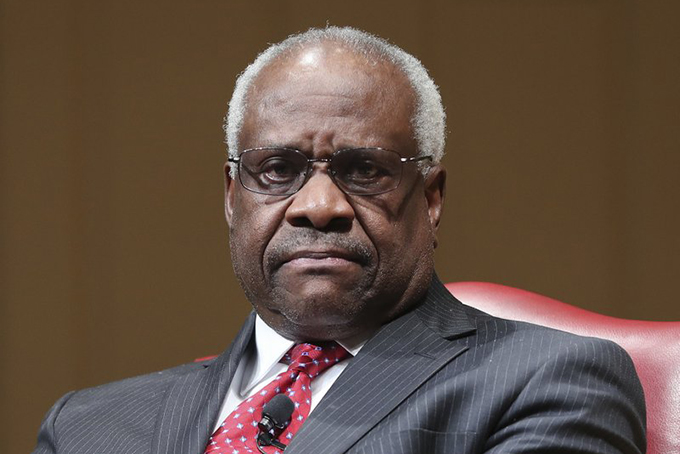


Supreme Court Justice Clarence Thomas recently delivered a lecture at the University of Texas at Austin commemorating the 250th anniversary of the Declaration of Independence.
The most contentious part of his speech was when Thomas stated, “At the beginning of the twentieth century, a new set of first principles of government was introduced into the American mainstream. The proponents of this new set of first principles, most prominently among them the twenty-eighth president, Woodrow Wilson, called it ‘progressivism.’ Since Wilson’s presidency, progressivism has made many inroads in our system of government and our way of life. It has coexisted uneasily with the principles of the Declaration.
Because it is opposed to those principles, it is not possible for the two to coexist forever.”

The left called Thomas’ speech historically inaccurate but failed to defend progressivism.
For example, in Matt Ford’s New Republic essay, “Clarence Thomas can’t get history straight,” he stated, “Thomas is correct that progressivism was introduced around the turn of the twentieth century, that Woodrow Wilson was the twenty-eighth president, and that Wilson was a progressive. The historical accuracy ends there. Presenting Wilson as the inventor of progressivism is historically illiterate, akin to saying that Joseph Stalin invented communism or that Ronald Reagan invented conservatism.”
Ford went on to say that the Progressive Era emerged in the 1890s from the corruption and excesses of the Gilded Age. A broad range of activists, journalists, politicians, and judges challenged the social ills that resulted from the nation’s rapid industrialization. Progressivism was made up of numerous movements, some of which overlapped and others did not. Thomas’ claim that progressives in general aspired to establish a ‘new set of first principles’ to replace the Declaration’s principles is baseless.
Ford defended Progressive Era social improvements, which Thomas did not reject. Thomas criticized a particular progressive worldview.
Ford admitted that “progressivism was made up of numerous movements,” which inadvertently means that progressivism had competing philosophies. Both Republican President Theodore Roosevelt and Democratic President Woodrow Wilson were strong supporters of progressive reform, but their approaches differed. Thomas criticized Wilson’s version of progressivism.
According to Ronald J. Pestritto, author of Woodrow Wilson and the Roots of Modern Liberalism, the founders had a long-standing notion of just governance. They based it on the “laws of nature and nature’s God,” as expressed in the Declaration of Independence. Progressives contended that each historical era should revise the goals and scope of government. Progressives paired this concept of historical contingency with a strong belief in historical progress, claiming that as history progressed, government became less of a threat to the governed and more capable of resolving the vast array of problems confronting humanity.
Pestritto stated that Wilson “championed historical contingency against the Declaration’s talk of natural law and permanent principles of just government.” Wilson acknowledged that the natural-law view of government was appropriate as a response to the prevailing tyranny of the Founder’s time, but Wilson contended that all government must be understood as a product of its historical period. The founding generation’s great sin was not their devotion to the idea of natural law, but their belief that the doctrine was supposed to transcend the specific circumstances of their time.
Thomas was correct that Wilson’s progressivism promoted the idea that “rights come not from God but from government,” but Thomas is wrong that the principles of the Declaration and progressivism were never meant to coexist.
Thomas stated that the Declaration stated the purpose of government was to protect our God-given, unalienable rights, which all individuals equally possess, but the Declaration did not establish a form of government—that was the work of the Constitution.
However, Thomas neglected to mention that the Founders also knew the Constitution required a Bill of Rights.
The founders demonstrated that rights derive from both God and government throughout the first ten amendments. There are amendments that prohibit the government from enacting laws that infringe on the natural rights of individuals, as well as amendments where the government grants rights to individuals. The protection of natural law can be found when the Bill of Rights prohibits the government from restricting the free practice of religion and prevents the government from subjecting individuals to cruel and unusual punishment, but rights granted by the government are expressed when it states individuals have a right to a speedy and public trial along with a court-appointed attorney.
Thomas’ progressive critics should have emphasized this point. Unfortunately, progressives judge people from the past using modern moral standards, and since Wilson is widely regarded as one of the most racist presidents in US history, no progressive was willing to jeopardize their reputation by defending Wilson’s views or challenge Thomas by claiming Wilson was right. Instead, they described Thomas’ speech as ill-informed, historically illiterate, and right-wing revisionist history.
Thomas’ speech was historically accurate, contrary to his progressive critics’ claims, but his historical analysis was deliberately one-sided.