


• July 1
1863—Walter Francis White is born in Atlanta, Ga. For nearly 25 years White was one of the most influential Black leaders in the nation. He headed the NAACP from 1931 to 1955. However, he first received national attention because of the way he looked. As a light-complexioned Black man with blue eyes, White was able to infiltrate racist groups and investigate planned brutality against Blacks. But in 1919, he barely escaped with his life while attempting to investigate the deadly Elaine Race Riot in Phillips County, Ark., which had left more than 200 Blacks dead. Somehow the mob discovered that White was in the area and set out to lynch him. But he was able to catch a train back to Little Rock before he could be identified. While on the train, the White conductor told him he was leaving town too early because the mob had discovered “a damn yellow Nigger passing for White and the boys are going to get him.” White would die in New York City in 1955. His autobiography is entitled “A Man Called White.”
1899—Thomas Andrew Dorsey is born in Villa Rica, Ga. Dorsey is widely credited with being the “Father of Gospel Music.” During the early 1930s, after leaving Atlanta for Chicago, Dorsey combined gospel and the blues while performing under the name “Georgia Tom.” He wrote more than 400 gospel and blues songs including his most famous “Precious Lord, Take My Hand.” He died in Chicago in 1993 at the age of 96. Once asked to comment on his life, Dorsey said, “I had hope, faith, courage, aspiration and most of all determination to accomplish something in life.”
• July 2
1777—Vermont becomes first U.S. territory to abolish slavery. By 1783, New Hampshire and Massachusetts had followed Vermont’s lead. The abolition of slavery was formally placed in the Vermont Constitution, which was formally adopted on July 8, 1777. A major force in the early abolition movement was a group known as the Rights of Man Movement.
1822—Denmark Vesey and five of his co-conspirators are hanged in Charleston, S.C. Vesey’s “crime” had been the organization of the largest slave rebellion in American history. But the insurrection was betrayed by a “house slave” before it could be implemented. Vesey was actually a former slave who had purchased his freedom.
1908—Thurgood Marshall is born in Baltimore, Md. Marshall would go on to become chief counsel for the NAACP and the lead attorney in the Brown v. Board of Education case, which led to the desegregation of the nation’s schools. President Lyndon Johnson would, in June 1967, nominate him to be the first African American Justice on the United States Supreme Court because as Johnson put it, “It was the right thing to do and the right time to do it.”
1943—Lt. Charles Hall became the first African American pilot to shoot down a Nazi warplane during World War II. Hall was from Brazil, Ind.
• July 3
1775—Prince Hall founds African Lodge Number One—the first Black lodge of Free Masons in the United States. Hall would become the pioneer builder of Black Masons in America. He was also a leading voice against slavery and for Black rights in the North.
1962—The first Black man permitted to play Major League Baseball, Jackie Robinson, is named to the Baseball Hall of Fame.
• JuLY 4
1922—Samuel L. Gravely is born. Gravely became the first African American admiral in the United States Navy and the first African American to command a U.S. warship. The Richmond, Va., native died in 2004 at the age of 82.
1972—College professor and activist Angela Davis is acquitted of charges that she assisted and conspired with the young men involved in a deadly 1970 shootout at the Marin County courthouse in California. The assault on the courthouse was an attempt to free imprisoned Black activist George Jackson. At least three people were killed during the escape attempt. Davis, a Birmingham, Ala., native who became a member of the Communist Party, spent 16 months in prison but on this day in 1972 she was found not guilty of all charges by an all-White San Jose, Calif., jury.
1973—Arna Bontemps dies at the age of 72 in Nashville, Tenn. Born in Louisiana, Bontemps became one of the key figures in the Black artistic and cultural movement known as the Harlem Renaissance of the 1920s and 1930s. Bontemps was a prolific writer and poet.
• JuLY 5
1872—The Republican Party National Convention takes place in Philadelphia with substantial representation from former Black slaves. At least three Blacks addressed the national political gathering. At this point in history, the Republicans were the nation’s most progressive party and attracted the allegiance of African Americans. Blacks would remain loyal to the Republicans until the 1930s. But by 1945 with the Republicans becoming increasingly conservative and attracted to the New Deal programs of Franklin D. Roosevelt, the vast majority of Blacks had switched to the Democrats.
1894—Black inventor G.W. Murray patents a fertilizer distributor, cotton chopper and a seed planter all on this day in 1894.
Dr. John Carlos, the 1968 Bronze medalist in the 200m, spoke on a panel recently in Washington, DC about the connection between the struggle he and fellow Olympian Tommie Smith endured to the #BlackLivesMatter movement. (Robert Roberts/The Washington Informer)
1945—Track star John Carlos is born in Harlem, N.Y. Carlos and fellow sprinter Tommie Smith created an international sensation when they protested American racism by giving the “Black Power” clinched fist salute when accepting their medals at the 1968 Olympics.
1956—Although the actual decision may have been reached the previous day, a federal district court hands down a ruling declaring that Alabama laws requiring racial segregation in public transportation were unconstitutional. The decision, which was later confirmed by the United States Supreme Court, was the first major legal victory for the Civil Rights Movement. It grew out of the historic Montgomery Bus Boycott sparked when Rosa Parks defied the law and custom by refusing to give up her seat on a public bus to a White man. Although actually organized by Rev. E.D. Nixon, the Boycott would result in Rev. Martin Luther King Jr. becoming the nation’s most prominent civil rights leader.
• July 6
1853—The first novel written by an African American is published on this day. However, the novel had to be published in England because the author William Wells Brown was a fugitive slave. The novel was entitled “Clotel” or “The President’s Daughter” and may have been partially inspired by the then rumored relationship between President Thomas Jefferson and the slave Sally Hemmings.
1862—One of the most pioneering and militant Black journalists in Black American history is born. Ida B. Wells-Barnett came into the world on this day in Holly Springs, Miss. The legendary journalist was also a relentless anti-lynching crusader and a fighter for women’s right to vote. She even made a stand against one of the more insulting laws of Jim Crow segregation nearly 70 years before Rosa Parks. In 1884, she refused to give up her seat on a train to a White man and move to an already over-crowded smoking car. It took the conductor and two other men to drag her off the train. She was among the group of Blacks and progressive Whites who helped establish the NAACP. When she was just 25 she established her lifelong attitude towards women being submissive to men declaring, “I will not begin at this late day by doing what my soul abhors: sugaring men, weak deceitful creatures, with flattery to retain them as escorts …” She died in Chicago in 1931.
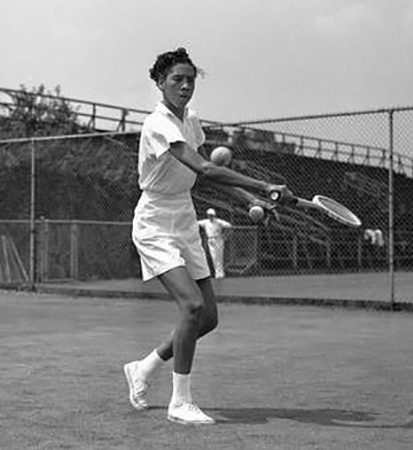
1957—Althea Gibson becomes the first Black person (male or female) to win the singles championship at Wimbledon. Gibson was born in Silver, S.C., and grew up in Harlem, N.Y. She died in September 2003. She often said she was driven to success in life by an attitude she developed during childhood. She summarized that attitude as “I always wanted to be somebody.”
1971—Henry T. Sampson invents the “gamma electric cell.” His invention and other engineering accomplishments had wide-ranging applications, but he did not invent the cell phone as some histories suggest. The gamma-electric cell converted nuclear radiation from reactors into electricity without going through the heat process.
• July 7
1906—Baseball legend Satchel Paige is born in Mobile, Ala. He was one of 15 children born to John and Lula Paige. Paige first learned to pitch in a reform school where he had been sent at the age of 12 for shoplifting. He spent most of his career playing in the old Negro Baseball Leagues prior to the integration of Major League Baseball. He is generally recognized as one of the greatest pitchers to ever play the game. Baseball great Joe DiMaggio once said Paige was “The best and fastest pitcher I ever faced.” Paige pitched his last game in 1965 at the age of 60 throwing three shutout innings. The great Satchel Paige died on June 8, 1982.