

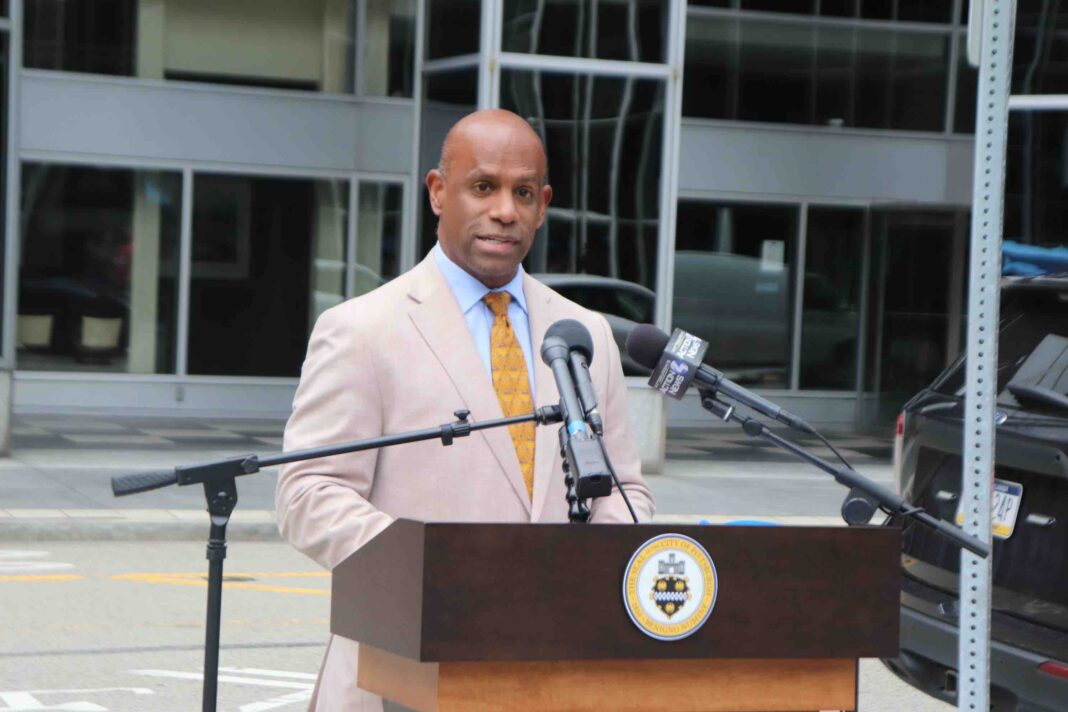

PAUL THORNELL, GREAT, GREAT GRANDSON OF GEORGE B. VASHON.
First Black graduate of Oberlin College, former President of Avery College
George B. Vashon is not a household name.
But his accomplishments in a time when Blacks were denied so much have posthumously earned him a spot in Pittsburgh history forever.
On Friday, June 26, 2026, about 70 officials, community advocates and leaders gathered at the corner of Third Avenue and Market Street, Downtown, next to where PPG Place stands. A historical marker was unveiled there for Vashon. That’s where he used to live. That’s where he opened his first business.
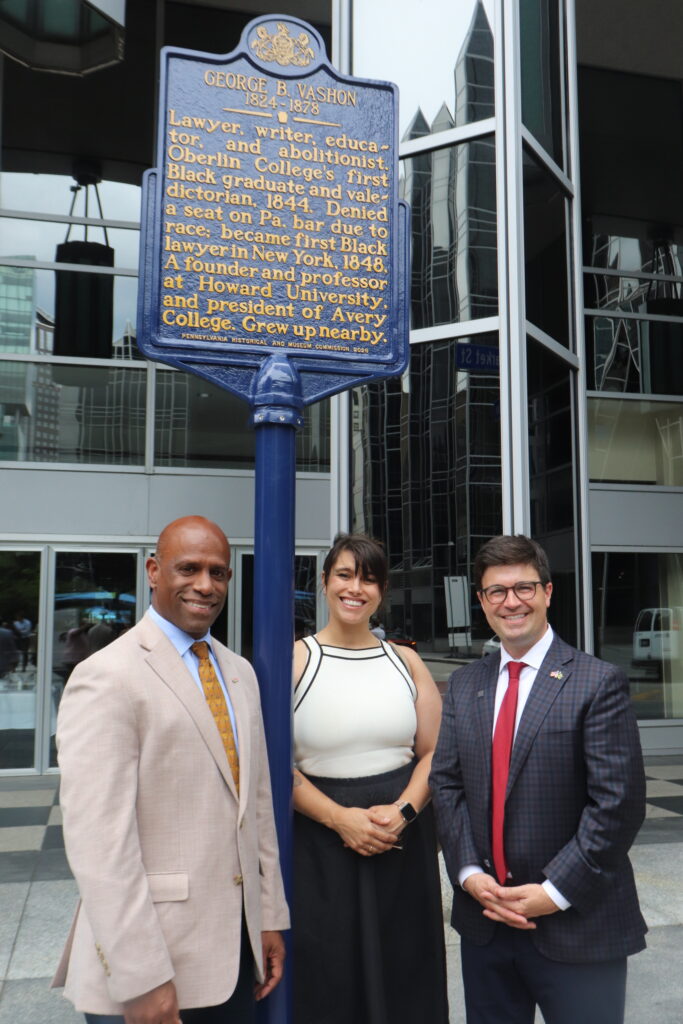
THE NEW HISTORICAL MARKER—George B. Vashon is forever recognized in Pittsburgh with his own historical marker, at the corner of Third Avenue and Market Street, Downtown. Pictured is his great, great grandson, Paul Thornell, along with Allegheny County Executive Sara Innamorato and Pittsburgh Mayor Corey O’Connor. (Photo by Rob Taylor Jr.)
George B. Vashon, who was born on July 25, 1824, in Carlisle, Pa., became the first Black graduate of Oberlin College in 1844. He became the first Black attorney in the state of New York in 1848, one year after he was denied practicing law in Allegheny County. At the time, state law declared that “Black men had no political existence.”
Vashon later became the first Black professor at Howard University, and was instrumental in establishing the Howard University Law School.
He was also instrumental in establishing the “Black Wall Street” that was home to Pittsburgh’s Black businesses along Third Avenue, Downtown. He also served as President of Avery College from 1863 to 1867, a school that provided elementary and advanced education to Black students regardless of gender. Avery College was in existence on what now is Pittsburgh’s North Side from 1849 to 1873.
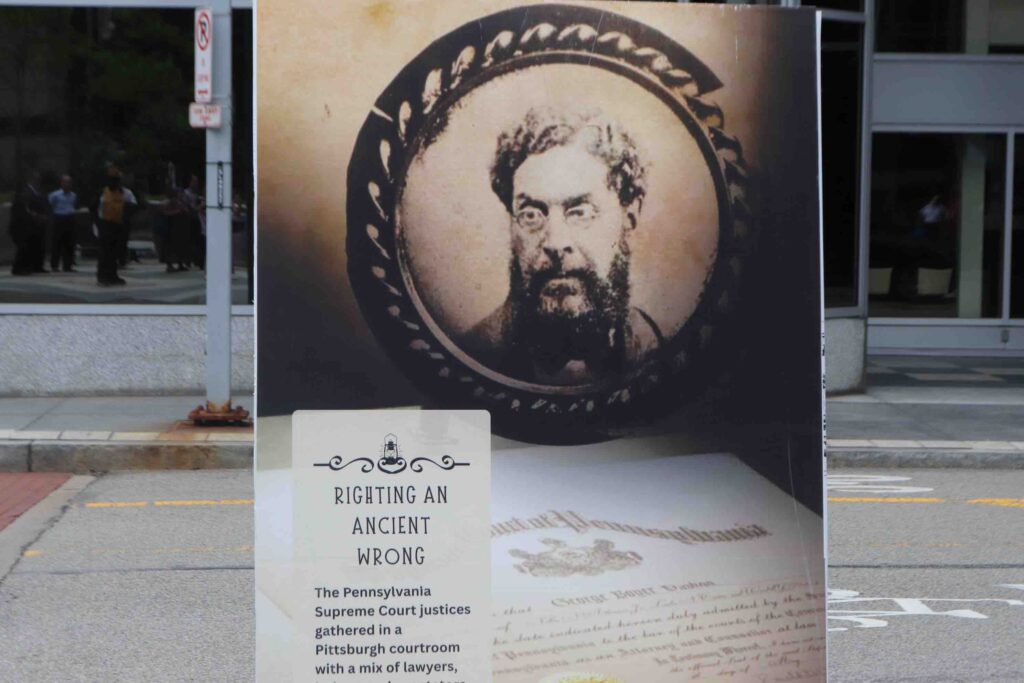
GEORGE B. VASHON
George B. Vashon died in 1878 at age 54.
Now, 148 years later, his story is being told, and his legacy lives on.
“Vashon’s achievements were extraordinary for a Black man in 19th-century America,” said Vashon’s great, great grandson, Paul Thornell, at the ceremony. “His extraordinary academic abilities at an early age, attending school with other Pittsburgh Black youth, excelling in math, literature and foreign languages in ways that would have been extraordinary for any well-schooled adult.”
Thornell said Vashon was exposed to the abolitionist movement through his father, John B. Vashon, a veteran of the War of 1812, and a leader of Pittsburgh’s Black community at the time.
In the 1860s, Vashon, who met his wife in Pittsburgh, moved to Washington, D.C., where he helped found Howard University. He later became a professor at what is now Alcorn State University, in Mississippi. Thornell said the death of George B. Vashon in 1878 was a result of the Mississippi Valley yellow fever epidemic.
“The way that you’ve been able to give some life and voice to what George B. Vashon did, I’m grateful to that,” Thornell said to City of Pittsburgh and state officials at the ceremony. “Because it is an important chapter that was unwritten, and in part is getting completed today, and with this marker, will be here for all-time. And as we unveil it today, I’m hopeful that the people of Pittsburgh recognize Vashon’s legacy and profound contributions to the nation, and will want to find out more.”
Pittsburgh Mayor Corey O’Connor added: “That’s the story we have to embrace as a city, individuals like George B. Vashon, who showed courage, determination, and what it was like to break barriers down, he started right here in Pittsburgh.”