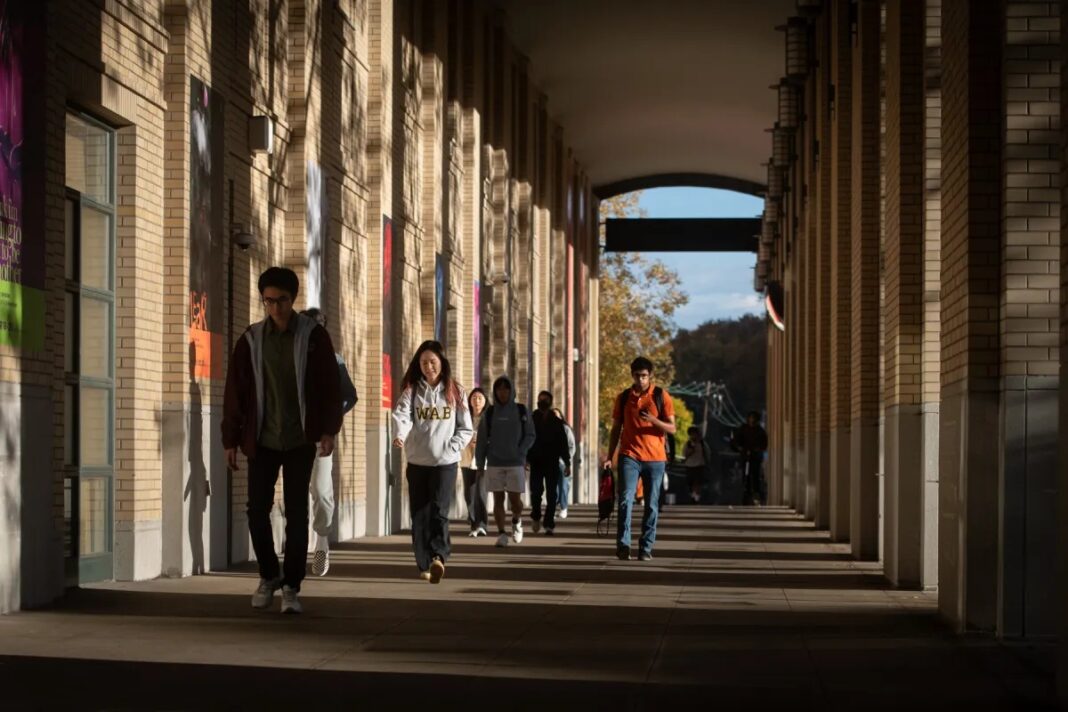
People walk through the morning light at Carnegie Mellon University’s campus on Thursday, Oct. 26, 2023, in Oakland. (Photo by Stephanie Strasburg/Pittsburgh's Public Source)
Carnegie Mellon University has seen heightened debate over expression since President Donald Trump visited campus in 2025. University President Farnam Jahanian’s comments following that visit come amid renewed campus discussions of The Fence and national concern about academic freedom.
Year-old audio of comments from Carnegie Mellon University President Farnam Jahanian, published last week by Pittsburgh’s Public Source, reveals pressure and tension surrounding free expression on college campuses in the U.S., according to national and local observers.
Charlotte Arneson, a campus rights program officer at the Foundation for Individual Rights and Expression (FIRE), said schools nationwide are facing the question: “Will university leaders uphold their commitments to free expression when speech becomes deeply controversial, or will pressure from community members, donors, public officials, alumni or media attention lead them to censor?”
This week, some CMU community members expressed concern to Public Source about whether Jahanian is prioritizing institutional needs over student needs. They referred to Jahanian’s explanation in the audio for why President Donald Trump was allowed on campus last year.
On July 15, 2025, the university hosted Sen. Dave McCormick’s inaugural Pennsylvania Energy and Innovation Summit. Two days later, Jahanian said at a university staff council meeting that McCormick, “a dear friend,” invited Trump to attend. Jahanian said, according to the audio, withdrawing that invitation would’ve been “nothing short of malpractice.”
Carnegie Mellon University President Farnam Jahanian (Courtesy of CMU)
“It was important for CMU to stay above politics and serve the community and serve the nation,” said the university president.
CMU History Professor Jay Aronson said university principles of free inquiry, free expression and open debate are worth standing up for, “even if that means short-term harm.”
“I would have handled things differently, but I am probably not as fiscally savvy or as aware of all of the things that are happening behind the scenes,” he said in an interview this week.
Aronson added that the Trump administration would not consider niceties when making decisions about which academic institutions are targeted. “They’re going to come for us no matter what. When they’re ready to come for Carnegie Mellon, they’re going to come for Carnegie Mellon.”
Public Source reached out to 24 campus members, including representatives from student government and clubs, faculty and staff members, to get their perspectives on Jahanian’s comments and where free speech stands at CMU. Few agreed to share for the record.
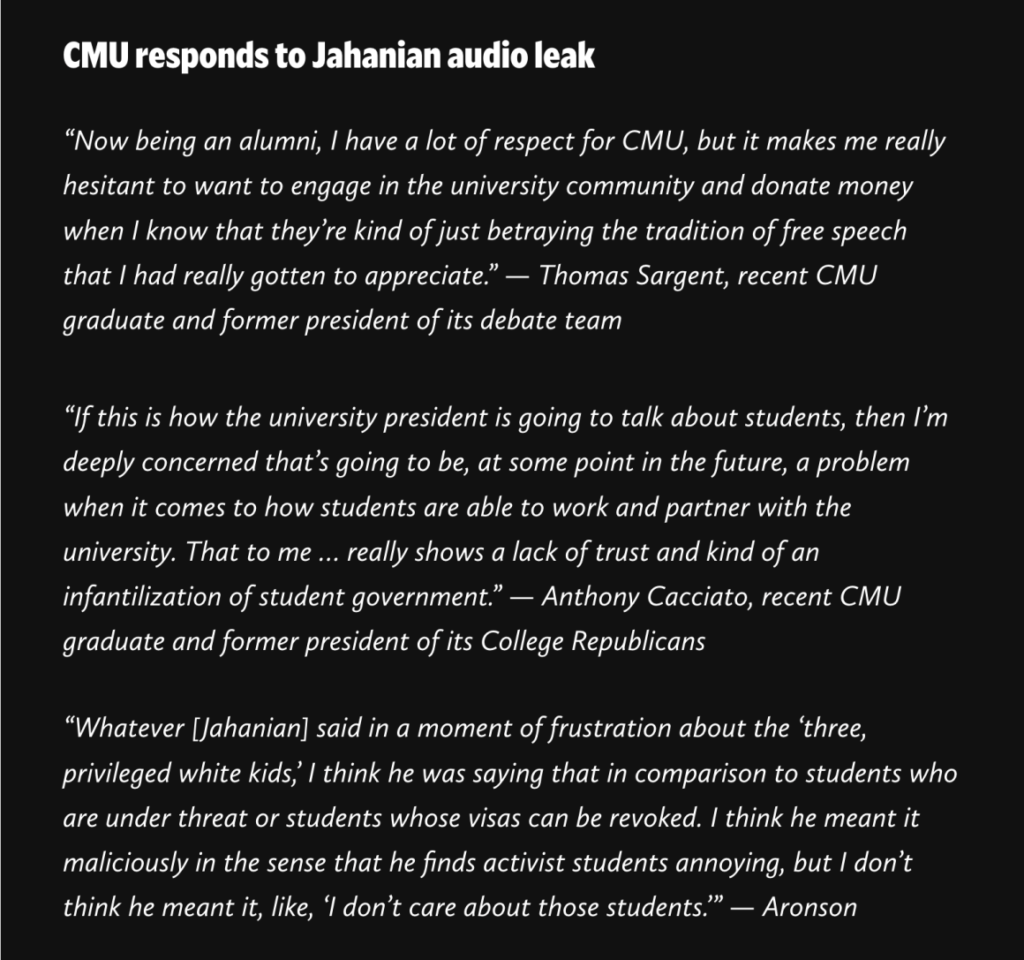
whose visas can be revoked. I think he meant it maliciously in the sense that he finds activist students annoying, but I don’t think he meant it, like, ‘I don’t care about those students.’” — Aronson
Rosalyn Tosh said she is one of the three students whom Jahanian referred to as a “privileged, white kid” in the leaked audio. She was involved in painting the Fence message “No rapists on campus” ahead of Trump’s visit last year, which led to the temporary closure of the longtime free speech structure.
Tosh said she was surprised to see that Jahanian’s comments — which she’d long known about — were made public. She said that shortly after the July 17 staff council, the university president met with the three students.
“Farnam apologized to three of us specifically for his words in the staff council meeting … I think both in email and in person,” Tosh said. “I saw his words as really being about three specific students and their actions, not a statement about his entire campus or the student body or even all of the participants in the original Fence painting.”
Tosh would like more clarity around what’s allowed on The Fence to stop the cycle of students painting messages that are then censored. Historically, only obscenity and threats of violence were prohibited on The Fence, and it has stood as an entirely student-regulated space for over a century.
The past year saw, for the first time, removal of messages from The Fence by university administration. These actions triggered a nonpartisan effort across 10 student groups to advocate for a policy preventing administrators from removing or altering messages.
The student groups delivered a petition with over 500 signatures to Jahanian in April, calling for the policy’s establishment. Anthony Cacciato, who formerly chaired CMU’s Young Americans for Liberty chapter, said the university president was “gracious” in listening to students, but “the way he responded was very dismissive.”
Cacciato said that Jahanian passed the petition along to the Fence Working Group, which he established last fall to examine how The Fence should operate on campus. Some CMU community members criticized the group’s selection process for lacking transparency and substantial student representation.
In June, the group released its recommendations, which included:
Celebrate The Fence as a space where students can express personal views, within the bounds of allowed on-campus speech
Describe The Fence as having shared governance between students and the administration, not as solely student-governed
Collaborate with the university’s student government to create guidelines for The Fence
Communicate to all that messages on The Fence represent the views of only those who painted them
Clarify that The Fence Instagram isn’t affiliated with the university
Allow administration to remove messages only in “rare, extreme cases,” to reduce the university’s liability.
Students paint words on the new fence outside of Carnegie Mellon University’s Warner Hall on July 21, in Squirrel Hill. (Photo by Stephanie Strasburg/Pittsburgh’s Public Source)
Aronson, along with faculty and students Public Source spoke to, took special issue with the final recommendation.
“The concepts of fiduciary duty and risk … have legal definitions, but I think they’re extremely vague, and I think the idea that censorship is under the purview of fiduciary duty is a big problem, and that’s exactly what led Farnam to decide to whitewash The Fence [last July],” Aronson said.
Within the last month, at least two Fence paintings have been fully or partially censored by CMU administration over what Jahanian called “threatening” messages. The messages were all related to the Israel-Palestine conflict, including the phrase “Death to Zionism,” which the administration painted over.
On Monday, CMU’s student newspaper The Tartan reported that eight individuals connected to recent Fence paintings are under university investigation, with seven temporarily barred from campus outside of attending classes.
A CMU spokesperson said they couldn’t comment on any active investigations, but that the university “must balance our longstanding commitment to free expression with our responsibility to uphold our community norms and standards and adhere to the law. When members of a protected group raise concerns about experiencing an unsafe or hostile environment, the university has an obligation under federal law to review those concerns.”
Maddy Franklin reports on higher ed for Pittsburgh’s Public Source, in partnership with Open Campus, and can be reached at madison@publicsource.org.
This article first appeared on Pittsburgh’s Public Source and is republished here under a Creative Commons Attribution-NoDerivatives 4.0 International License. PARSELY = { autotrack: false, onload: function() { PARSELY.beacon.trackPageView({ url: “https://www.publicsource.org/cmu-president-recording-reflects-free-speech-tensions/”, urlref: window.location.href }); } }