
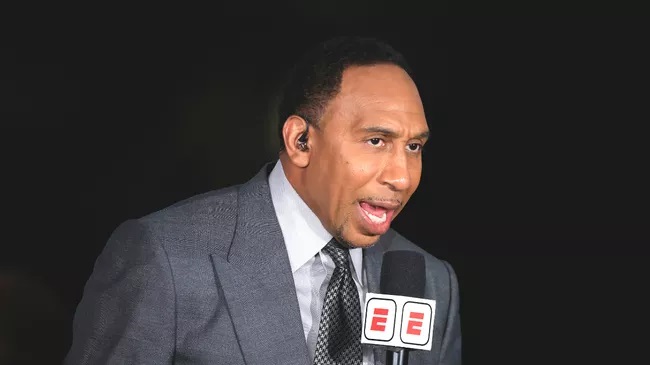


The National Association of Black Journalists was right to give sports and political commentator Stephen A. Smith a “Thumbs Down” award at its annual convention in Atlanta last week.
NABJ said the distinction was based on Smith’s “recurring public pattern of disparaging commentary directed at Black women across politics, sports and media.”
The organization did not pull that criticism out of thin air. Over the years, Smith has repeatedly found himself at the center of controversies involving Black women, leaving many to wonder why his criticism so often seems aimed in the same direction.
But while much of the conversation has centered on Smith himself, the larger issue extends far beyond a single television personality. The real concern is misogynoir, a term coined by educator Moya Bailey, which is racism and sexism directed specifically at Black women.
It is the act of subjecting Black women to a level of scrutiny, ridicule and hostility that often exceeds what others face. It appears in politics, business, entertainment, journalism and sports. It shows up in workplaces, online spaces and even within Black communities.
Smith did not create misogynoir, but he has too often contributed. The list is long.
He questioned whether Vice President Kamala Harris was being elevated because she was the most qualified candidate or because she was a Black woman. He publicly feuded with former MSNBC host Joy Reid, frequently attacking the Harvard graduate’s credibility and commentary. He criticized former Texas Rep. Jasmine Crockett’s stance against President Donald Trump, often reducing policy disagreements to personal jabs. He took shots at tennis star Serena Williams for dancing during a Super Bowl performance with rapper Kendrick Lamar.
Smith has clashed with ESPN’s Malika Andrews and NBA analyst Monica McNutt, in exchanges that sparked broader conversations about the treatment of Black women in journalism.
Even Michelle Obama has not been spared. Smith has attacked the former first lady’s political messaging, particularly comments she made during the 2024 campaign stating that “a vote for (Donald) Trump is a vote against us.”
Disagreement is fair game. Public figures should be challenged. The question is why so many of those challenges from Smith seem disproportionately directed at Black women.
The irony is difficult to ignore as Smith himself has been a target of Trump’s insults. Trump once publicly called Smith stupid, which the commentator largely brushed it aside, saying he was a “big boy” who could handle criticism.
Yet when NABJ held him accountable, his response was not nearly as dismissive.
Instead, Smith launched into a lengthy defense, citing his upbringing with four sisters, his relationship with NABJ and the fact that he had brought ESPN’s “First Take” to the organization’s convention. Then, rather than primarily addressing the concerns raised by Black journalists, he took his grievance tour to White, conservative media outlets such as NewsNation and Fox News.
That response largely missed the point. This was never about whether Smith has a right to express his opinion. Of course he does.
This was about whether one of the most influential Black voices in media bears some responsibility for the messages he sends and the targets he chooses, it’s about whether Black women have earned the right to ask that question. Their experience in America is one of extraordinary achievements despite extraordinary obstacles.
Within a few generations, Black women have gone from being denied basic rights to becoming the most educated demographic in the nation. They have built businesses, led social movements, organized communities and shaped elections. They remain among the country’s most engaged voters and some of its most effective advocates for educational opportunity, public health, social justice and much, much more.
Yet they continue to face systemic barriers.
Data from the National Intimate Partner and Sexual Violence Survey show that roughly 41 percent to 45 percent of non-Hispanic Black women will experience physical violence, rape or stalking by an intimate partner during their lifetime.
The challenges extend into the workplace.
Research by LeanIn.Org and McKinsey & Co. has consistently found that Black women begin their careers with representation rates comparable to many peers at the entry level. But their numbers decline sharply at each stage of promotion.
In other words, Black women are constantly being asked to do more with less. Less institutional support. Less access to influence. Less protection from bias.
That reality is what makes the NABJ decision important. The organization was not merely criticizing one commentator. It was sending a message that Black women deserve better from the people who share their communities, platforms and institutions.
We stand with NABJ President Errin Haines.
She is right. Accountability is not cancellation. Accountability is a conversation.
And to her credit, Haines has made clear that the door remains open. In an interview with national news outlet Capital B, Haines said NABJ hopes to engage individuals and institutions in discussions about what meaningful change looks like and what steps can be taken moving forward.
For a man raised by a Black mother, surrounded by Black women throughout his life and now raising two Black daughters, Smith should better understand the weight his words carry.
The issue is bigger than Smith. It is bigger than a television segment, a social media clip or an award handed out at a convention. The issue is whether Black women will continue to be asked to carry communities, workplaces and movements while simultaneously absorbing unwarranted criticism from those who benefit from their work and leadership.
NABJ got this one right.
(Reprinted from the Philadelphia Tribune)