
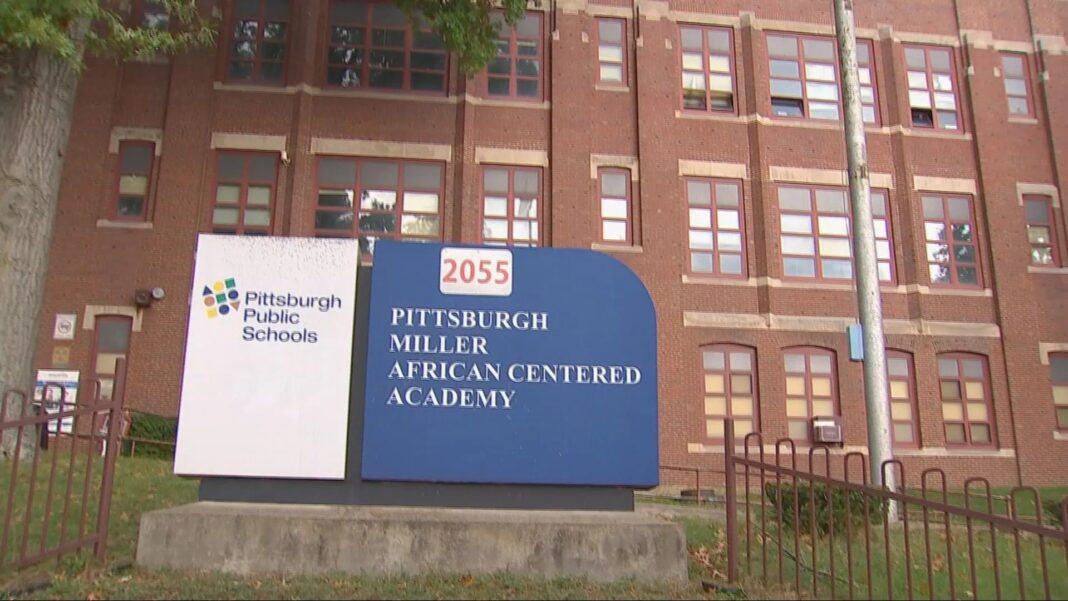


In a neighborhood where generations of Black families have fought to preserve their institutions, the future of Miller African-Centered Academy has become the latest struggle over education, community identity and the preservation of Black history.
Parents, students, alumni and community advocates are calling on Pittsburgh Public Schools to reverse its decision to close the Hill District elementary school at the end of the 2026–27 academic year. The school is the district’s only elementary academy specifically dedicated to teaching African heritage and Black cultural identity.
The campaign intensified this month, with supporters gathering outside Miller on October 23 and returning to address the school board during an October 26 public hearing.
Their message was that closing Miller would eliminate an educational model that families deliberately chose for their children.
Located on Bedford Avenue, Miller incorporates African history, cultural traditions and the Nguzo Saba, the seven principles associated with Kwanzaa, into its educational approach. The school’s emphasis on cultural identity distinguishes it from other elementary schools in the district.
For families, the prospect of losing that approach has raised concerns about what students will experience when they are reassigned elsewhere.
The school board voted 6-2 in May to approve its Future-Ready Facilities Plan, a sweeping restructuring that will close nine school buildings, eliminate or consolidate several school programs and reorganize attendance assignments across Pittsburgh.
District officials maintain that the changes are necessary to address declining enrollment, aging facilities and unequal access to educational resources.
Under the approved plan, Miller students will be reassigned to either Weil Elementary in the Hill District or Liberty Elementary in Shadyside.
But for some parents, the change also means losing the ability to send their children to a neighborhood school within walking distance.
Kayla Johnson, a Miller graduate whose daughter now attends kindergarten there, told WTAE that the reassignment would require her child to ride a bus rather than walk to school, creating new challenges for her family.
Other advocates have questioned whether the district’s restructuring places an unequal burden on Black students and neighborhoods.
During the October 26 hearing, Tim Stevens of the Black Political Empowerment Project emphasized Miller’s connection to Pittsburgh’s history of Black educational advancement.
That history reaches back to the 19th century, when Black Pittsburghers organized to secure educational opportunities for children who faced racial exclusion.
Today, advocates see Miller as part of that continuing tradition, connecting classroom instruction to a broader understanding of African American history and community achievement.
The opposition has also moved beyond public demonstrations.
In July, parents of five Pittsburgh Public Schools students filed a discrimination complaint with the Pennsylvania Human Relations Commission, alleging that the district’s closure plan disproportionately harms Black students. The families represent children attending Miller and two other schools scheduled for closure.
The complaint remains an allegation, not a finding that the district violated civil rights law.
Pittsburgh Public Schools has acknowledged Miller’s cultural significance while maintaining that the broader restructuring is intended to improve educational opportunities.
District spokesperson Ebony Pugh previously said officials recognize that culturally responsive instruction and an African-centered educational model are not interchangeable. The district has pledged to work with school communities to identify ways to preserve their histories and traditions during the transition.
Still, families are seeking more than assurances that elements of Miller’s culture will be remembered.
They want the school itself to remain open.
At an October 27 community meeting, district officials outlined implementation plans and acknowledged that important details remain unresolved. Superintendent Wayne Walters has indicated that reconsidering Miller’s closure would be a decision for the school board.
That leaves supporters continuing their campaign as the district prepares for next year’s transition.
For the Hill District, the debate reaches beyond enrollment figures and building utilization. It raises a question about what happens when a school created to affirm Black history and identity is removed from the public education system.
Whether the board revisits its decision remains uncertain. What is clear is that Miller’s families intend to keep the issue before district leaders as the closure date approaches.