

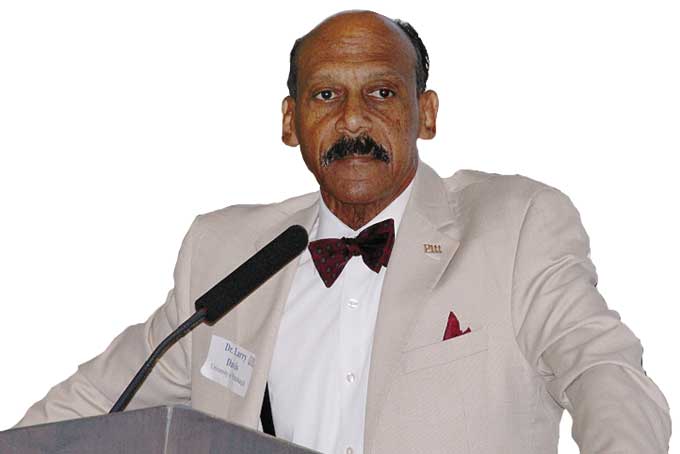
Recently, University of Pittsburgh Dean of the School of Social Work and Director of the Center on Race and Social Problems Larry Davis, MA, MSW, PhD, visited the New Pittsburgh Courier and chatted with editors about Black on Black Violence, race in America and his current projects.
While many talk about the issue of police brutality, the tragic epidemic of Black on Black shootings and killings continue to plague Black communities across the country, and it looks as if no end is in sight.
“In the Vietnam War, there were 58,000 troops killed, 7200 of them were Black; and the war lasted for 13 years. It took 13 years to kill 7200 Black people. We (Blacks) have, on average, killed somewhere between 9 (thousand) and 5,000 every year,” Davis said, pointing out an astonishing statistic. “Black America has the equivalent of the Vietnam War every year. It took 13 years to do it for the Vietnam War and we’ve done it every year for the last 30 or 40 years.
“National leaders march, demonstrate and speak out against police brutality, but where are their voices when a young Black male shoots another young Black male, in broad daylight? Where’s the national outrage then?”
When asked the question, Davis said he believes that many leaders are outraged, but that they just have trouble “getting their arms around” the issue and how to stop it.
Although he says there are many contributing factors to the violence and destruction, Davis said there is one main solution for the problem—employment.
“We have to have more employment opportunities for youth because they gotta do something. They are going to get money from somewhere; they’re not going to just sit there and starve and do nothing.”
Davis said it takes letting youth see employment opportunities sooner in life, job creation within the Black community and reaching out to youth on their level.
“We need to talk to kids on their level, about what they want to talk about,” he said. “We have to demonstrate to our kids the value of education, and that it pays off. Go to them with what they value. It is important that we show them, ‘this is the way you can make money and not end up in jail.’”
He said it also takes finding an answer to the question, “Why Not?”
“If you don’t have a job, why not stand on the corner and drink wine? If you don’t have anywhere to go, why not stand on the corner and do drugs?
“Until alternatives can be presented, there is no incentive for individuals to do otherwise.
“We really have to get jobs. We have to lobby for greater economics. It’s like boxing. In boxing everything works off jabs, in life everything works off jobs.” He added, “If (the government) had put the money in Black America that they put in the Middle East in the last five years, we’d be in great shape.”
Along with employment, Davis said there are two other things need to happen in the Black community: Cops who harm Black people need to be punished and there needs to be a higher percentage of Black officers on forces; they need to look like the demographic of the city they serve. “One of the best diversity trainings for White people are Black people,” he said.
Two weeks ago, the country was rocked by the racially charged terroristic attack that took place when 21-year-old Dylann Roof entered the historic Mother Emanuel AME Church in South Carolina and slain nine church members, including the pastor, during their Bible Study. As the nation heals, many have said this is a time to have discussions about race to address racism in the country.
Currently, Davis is working on his latest book, “Why Are They Angry With Us?” He said the eight chapter book is a personal history of race and social science, and that he wrote it for his children, so that they could know the stories within it. A publication date was not given.
The real source of racism or any –ism, according to Davis, is advantage. “It’s always about the advantage and how you sustain advantage. Attitudes are the supporters of the attitude you want to engage in,” he said. “If I can charge you more for land, why not? If I can pay you less for doing work, why not? If I can vote and keep you from voting, why not?”
It is about one wanting to have an advantage over another, he said.
Davis agrees racism is a discussion that needs to be had and even applauded Starbucks for their efforts in attempting to discuss racism through their “Race Together” campaign. The short-lived campaign was not very well accepted among many of its customers.
While he has earned some notoriety through his achievements as a dean, director, professor, author and expert, Davis does not take it lightly. He said he is currently trying to figure out what role he can take in aiding the Black community.
Follow @NewPghCourier on Twitter https://twitter.com/NewPghCourier
Like us at https://www.facebook.com/pages/New-Pittsburgh-Courier/143866755628836?ref=hl
Download our mobile app at https://www.appshopper.com/news/new-pittsburgh-courier

‘We really have to get jobs’…Davis talks jobs, racism and upcoming book
From the Web