

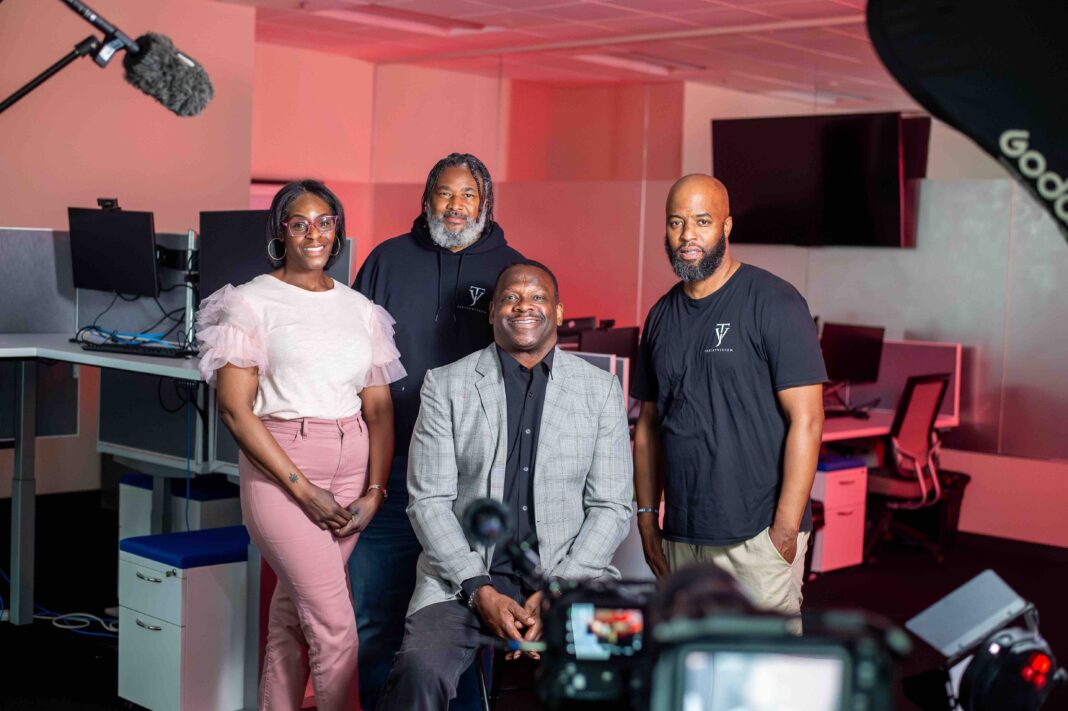

FORMER PITTSBURGH STEELER AND WELL-KNOWN ENTREPRENEUR CHUCK SANDERS, SEATED, WITH, FROM LEFT TO RIGHT, ALLEGRA BATTLE, BRETT ALLEN AND TASHEE “TEE JAY” JOHNSON. (PHOTOS BY MARLON MARTIN)
Documentary being produced on station’s history, impact
by Naomi C. Ilochi
For New Pittsburgh Courier
Pittsburgh has been known for many things, from its steel mills, to its sports teams, to its bridges, to its radio stations. One radio station in particular, being WAMO.
WAMO began in Homestead in 1948, initially as “WHOD,” later switching to “WAMO” in 1956; the name stemming from the Allegheny, Monongahela, and Ohio rivers. WAMO provided the Black community with R&B and soul music, with some calling it “a window on the African American experience in Pittsburgh.”
WAMO would go on to close in 2009, following the selling of the radio station by its owner Sheridan Broadcasting to St. Joseph Missions for $8.9 million.
Tashee Johnson, better known as “Tee Jay,” worked at WAMO for some 15 years. He is best known as being one half of the “Bad Boyz” on WAMO’s evening show in the late 1990s. These days, he’s the CEO of “Tee Jay Vision, LLC,” a multi-media production company specializing in film and television. Johnson has been working on a documentary on the history of WAMO and what it meant and still means to Pittsburgh’s Black community. The documentary is called, “WAMO: The Sound of the Steel City.”
“For the most part, I worked for WAMO for 15 years, pretty much on and off and I started when I was 19, 20, until they closed in 2009,” Johnson said.
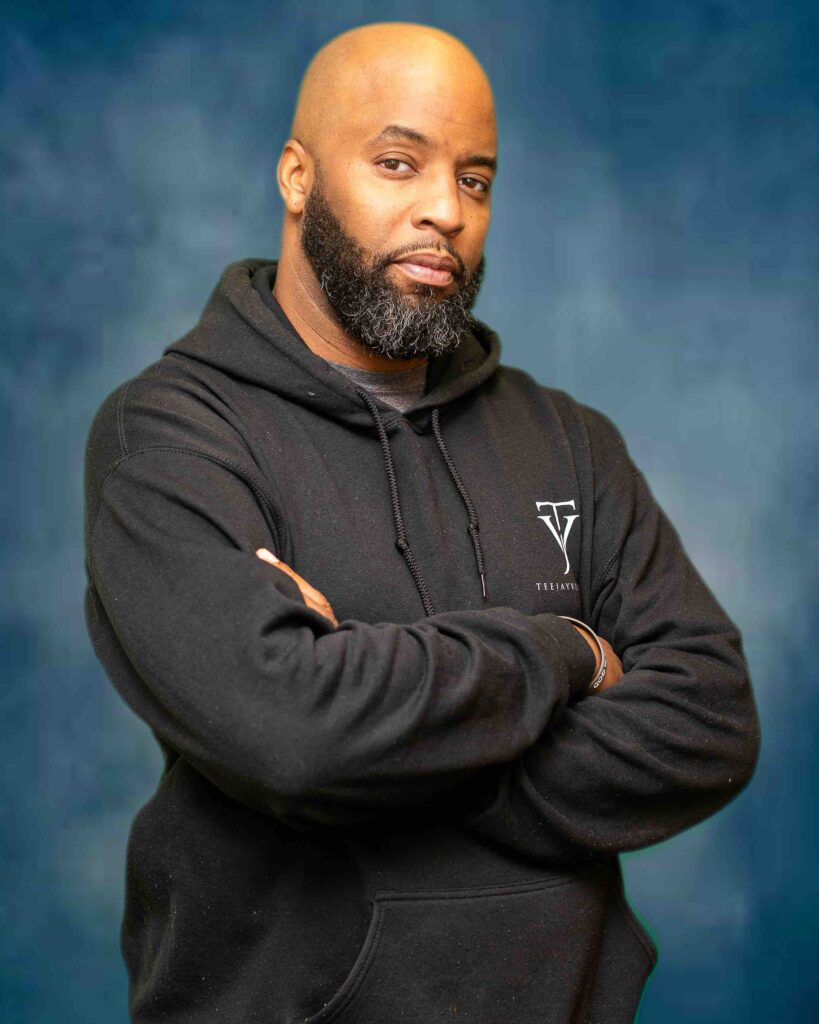
TASHEE “TEE JAY” JOHNSON
WAMO would come back on air in Pittsburgh in 2011 by way of “Martz Communications Group” as WAMO 100 (100.1 FM), restoring the voice of Pittsburgh’s Black community after a two-year departure. WAMO would then go on to have its programming and intellectual property acquired by the radio broadcasting giant “Audacy” from Martz. Audacy Pittsburgh also owns KDKA-AM (1020, 100.1), 93.7 The Fan (sports), 100.7 Star (CHR), and Y108 (Country). Audacy acquired the intellectual property of WAMO in 2022.
“Being a part of the rich history of WAMO, the legacy…I thought it’d be a great time to be able to tell the story and really document what really went on and what people saw and what was behind the scenes,” Johnson added.
This documentary seeks to accomplish preservation, a widening of perspective and lifting of “the veil” to show people what really went on behind the scenes at a station like WAMO.
“To be able to catalog its history is enough in itself for me. To be able to preserve it, to be able to share with people what really went on and the history and understanding, how impactful WAMO really was,” Johnson told the New Pittsburgh Courier. “A lot of people have their thoughts and ideas about what WAMO and what a radio station should be, but very few people are able to look beyond and behind the veil to see what really goes on and some of the internal struggles, some of the exterior struggles that go on, and had to be done in order for us to even have a free radio station. I want to share some of that story and really allow people to see and understand the true culture of what WAMO was even though they may have their complaints and they might have their disagreements on the execution. The fact that it’s (WAMO) undeniably a part of Pittsburgh, I want to preserve that.”
As the country battles the economic crisis, Johnson is emphatic that donating to the funding and operations of the documentary’s $25,000 goal will go on to help preserve history. “I think oftentimes there comes projects, there comes moments where, collectively, if we stand together we can accomplish so much more. And right now a lot of this has been personally out of my pocket or my mentor. He and I have been working together and trying to raise funds, but it hasn’t really come to the place that we really can do it full-throttle the way we want to. I understand these are tough economic times. And so that being said, I’m very careful how I ask and who I ask and even the amounts, but I think this is a wonderful cause. I think you can’t go wrong with preserving our history. You can’t go wrong with preserving our legacy and the impact. I think these are one of the stories that needs to be told so you know what has been done won’t be forgotten.”
Johnson continued: “WAMO in and of itself has changed hands, and because it’s changed hands, if you’re getting caught up in what it is today, you might miss what happened yesterday, and yesterday has everything to do with today.”
This documentary is for everyone of all ages, from Gen Zers to Millennials, to Boomers.
“There are people who are older than me, who understand the power of Porky Chedwick (known as the “The Daddio Of The Radio”), Sir Walter (John Christian, a trailblazing Black broadcaster who worked in radio at WAMO and WPXI-TV), and those who are obviously younger than me. I think there needs to be a part that can bridge all three of these gaps, all these different generations. I think with the understanding of why you are here, and appreciation of the steps and the trails that have been blazed for you to be where you are, I think it’s important.”
Today, most radio stations that serve a majority-Black audience are not Black-owned, as is the case with WAMO (now on 107.3 FM). Legendary radio stations with largely Black audiences like Hot 97 in New York, WGCI in Chicago and WPGC in Washington, D.C., are also not Black-owned. However, Cathy Hughes, a Black woman and owner of Urban One (which also owns TV One), owns the largest number of Hip-Hop, R&B and Gospel stations across the country, including WZAK and Z107.9 in Cleveland. Aside from Urban One, though, the number of Black-owned radio stations these days are slim.
That’s why WAMO was even more celebrated. In 1972, Ronald R. Davenport, a Black man who at the time was dean of the Duquesne University Law School, purchased WAMO through his company Sheridan Broadcasting. WAMO became Black-owned and stayed that way until 2009. Most of Johnson’s WAMO documentary focuses on when WAMO was owned by Sheridan Broadcasting.
Johnson serves as director of the documentary. Alan Lincoln, former WAMO general manager, is executive producer of the documentary. Allegra Battle, who spent time at WAMO on-air in the news department, is a writer for the documentary. Harriet C. Jackson, who spent time as a producer and morning show co-host at WAMO, is a producer for the documentary. Brett Allen is director of photography for the documentary.
As part of the creation of the documentary, Johnson has been steadily holding on-camera interviews with many former WAMO employees, like Sly Jock, Toss Swaid, Lisha Logan and J.J. Stone.
Brother Marlon Martin, the current host of the Sunday morning inspiration program “I Praise” (7 to 11 a.m.) on WAMO 107.3, began his journey with WAMO as an intern in 1994. He went on to host shows such as “Club 106,” the “Quiet Storm” and “The Breakfast Jam.” In those days, he was known on the air as “Sean Richards.” He’s hosted the Sunday morning program on WAMO, when WAMO was on the air, since 2006.
“WAMO, to me, is everything,” Martin told the Courier. “I wouldn’t be who I am, people wouldn’t know the person that I am, the gifts and abilities I have, if it had not been for WAMO. WAMO locally was the heartbeat and the pulse of Black Pittsburgh; we didn’t go anywhere unless we heard it on WAMO because that’s where we got all of our information. We fell in love with all of the personalities that we grew up with, and for me it was not only an added bonus that I got to listen to them, but I got to work with them.”
“WAMO: The Sound of the Steel City,” will be shown on Feb. 28 at the August Wilson African American Cultural Center. To donate to the documentary, visit gofundme.com and search “WAMO documentary.”