
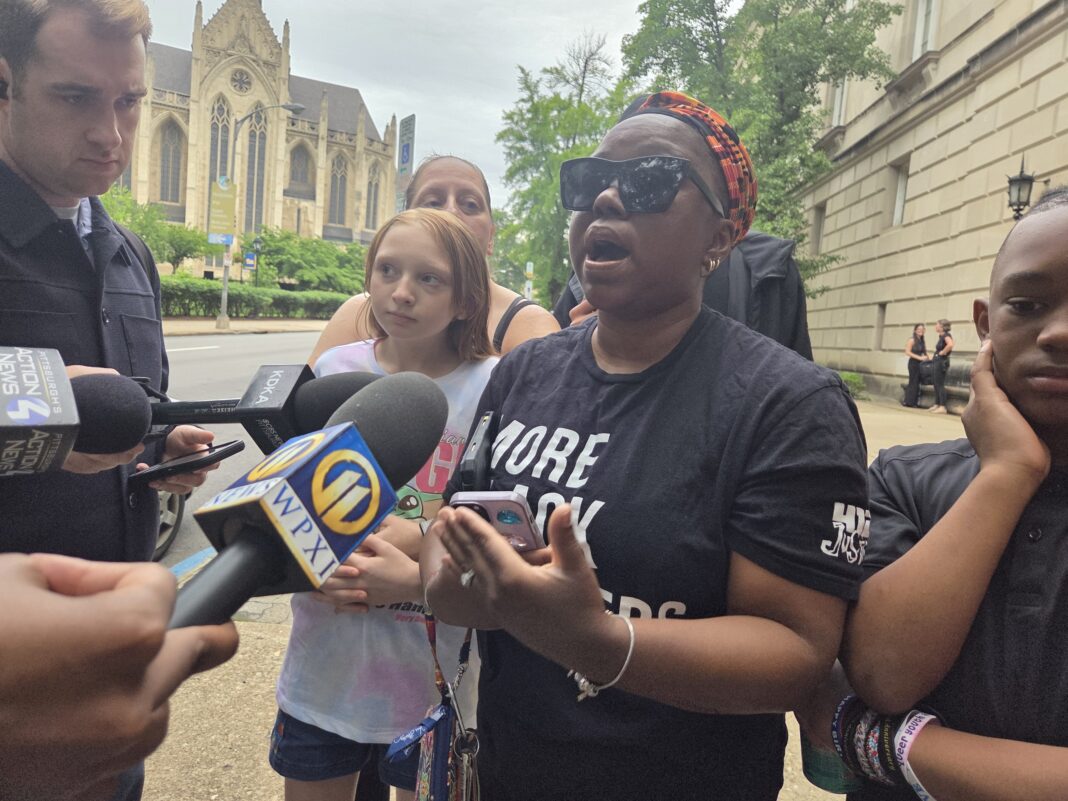


JAZLYNN WORTHY, a mother of kids in Pittsburgh Public Schools, is 100 percent against closing schools. However, the PPS Board of Directors voted in favor of 12 schools closing over the next few years. (Photo by Rob Taylor Jr.)
Editor’s Note: This story has been altered online as of June 11, 2026. There is no longer any mention of feeder school patterns.
The Pittsburgh Public Schools district is going to look a lot different in a few years.
Nine less physical buildings. Twelve less schools. Different grade configurations.
Ask the superintendent and the school board president, and they’ll tell you the changes are necessary.
Ask many parents of kids in the district, and they’ll tell you the exact opposite.
“Every single one of y’all should be ashamed,” said PPS parent Jazlynn Worthy, a Black woman who has ties to the advocacy organization 412 Justice, and who advocated that PPS not close schools. Worthy was inside the school board chambers at the district administration building when the board made its 6-2-1 decision to close the 12 schools, May 27. “Watch it be a (expletive) disaster,” Worthy exclaimed as she was led out of the chambers.
“My kids’ future, down the toilet,” Worthy exclaimed.
For years, Pittsburgh Public Schools has been grappling with the reality that its district, built for 40,000 students, has an enrollment that isn’t even half of that number today. There are about 18,000 students in the district these days, good enough for second-largest in the state, but a far cry from the more than 32,000 students PPS had in the 2005-06 school year, which wasn’t that long ago. That’s a 39 percent decline in student enrollment in the past 20 years.
PPS Superintendent Dr. Wayne Walters unveiled a “Future Ready Facilities Plan” to combat the declining enrollment and financial woes, which included the closures of Baxter (Student Achievement Center), Friendship (Montessori), Fulton PreK-5, McKelvy (Miller PreK-5), Morrow Primary, Schiller 6-8, Spring Hill K-5, Woolslair PreK-5, Manchester PreK-8, Allegheny 6-8, Arsenal PreK-5 and King PreK-8.
Included in the plan, although not discussed as much as the school closure debate, is PPS’ move to have just three grade configurations in its schools—K-5 foundational schools, developmentally responsive 6-8 middle schools and traditional 9-12 high schools. Right now, there are five grade configurations. The PreK-8 and 6-12 grade configurations would go away with the Future Ready Facilities Plan.
PPS said in a news release that the average age of district school buildings is roughly 90 years, and the Future Ready Facilities Plan could “avoid more than $100 million in future facility costs while allowing for more than $103 million in investments in modernized learning spaces over the next seven years.”
“Tonight’s vote represents an important step toward creating learning environments that reflect the excellence and opportunities our students deserve,” said School Board President Gene Walker. “This plan positions Pittsburgh Public Schools to better serve students for generations to come while remaining focused on equity, opportunity, and long-term sustainability.”
“The approval of the Future Ready Facilities Plan represents a transformational investment in the future of our students, schools, and communities,” added Dr. Walters. “This plan is about far more than buildings. It is about creating equitable opportunities, strengthening academic experiences, and ensuring every student has access to learning environments that support success in college, career, and life.”
The six PPS board directors who voted in favor of the plan were Walker, Tawana Cook Purnell, Yael Silk, Eva Diodati, Dwayne Barker and Tracey Reed. The two PPS board directors who voted against the plan were Emma Yourd and Devon Taliaferro. Board Director Erikka Grayson abstained from the vote due to her employment at the Boys and Girls Clubs’ Lawrenceville location as a Senior Clubhouse Director. She called it a conflict of interest.
Taliaferro was the most outspoken against the Future Ready Facilities Plan. During her remarks before the votes were counted, Taliaferro said she’s had “countless conversations, text messages, Facebook DMs,” etc., from people sharing their thoughts about the proposed PPS plan, “and the impact that this decision will make on them. And I don’t discredit those voices; in fact, many of those voices I represent. Five of the schools on this list are in District 2.”
Taliaferro slammed the school board for not listening to the constituents, the parents, etc., who didn’t want this affirmative vote to close schools.
“I thought when we run for school board, that we are servants of the people. And to disregard those voices because they’re too many, or they’re too loud or too privileged…”
“Everything I do is for little Black and brown children,” Taliaferro added, “because if we do it right for them, everyone else will be fine.”
While Black students make up more than half of the student enrollment in PPS, there are some schools that are a vast majority African American, like King PreK-8 on the North Side, and McKelvy (Miller PreK-5) in the Hill District.
Communication with PPS parents, Dr. Walters said, is happening now and will remain as such to keep parents informed on all PPS happenings pertaining to the Future Ready Facilities Plan.
“We have to consolidate,” Dr. Walters said to reporters after the 6-2-1 vote on May 27 at the administration building. “Change is hard, and this was not easy…but it’s something that we have to do and it’s necessary now. Our Board of Directors, they’ve spoken, and now the work is on implementation and being very thoughtful about it, being very communicative about it, and really just being centered on our students and making sure that their experience with this transition is one that is healthy and works for them.”