
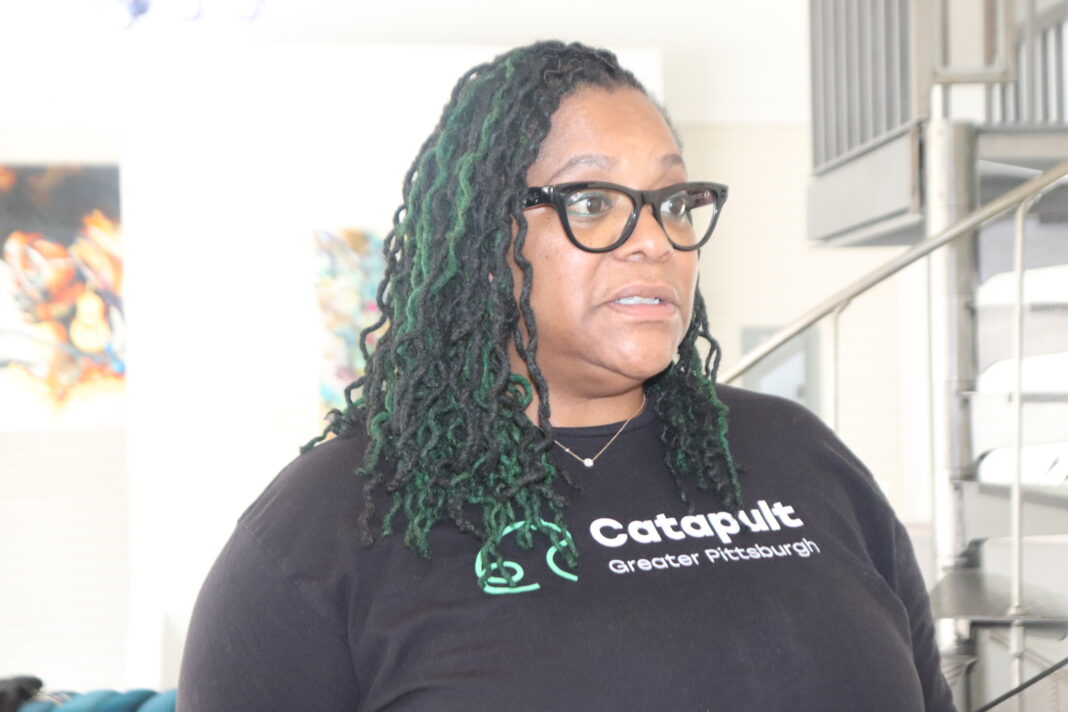


“The new administration has done everything in its
power to obliterate down payment and closing costs
assistance programming.”
TAMMY THOMPSON
President & CEO, Catapult Greater Pittsburgh
The non-profit organization Catapult Greater Pittsburgh, led by Tammy Thompson, has helped more than 100 people in Allegheny County become homeowners, the vast majority of whom are African Americans.
But this year, 2026, they haven’t been able to help as many people become a new homeowner, and Thompson said it’s all because of one person.
Donald Trump.
“The new administration has done everything in its power to obliterate down payment and closing costs assistance programming,” Thompson told the New Pittsburgh Courier in an exclusive interview, June 26. “They’ve made it almost illegal for banks to offer special purpose programming that has supported Black homeownership over the years. So without those subsidies, without those special purpose programs, getting low- to moderate-income families into homeownership has been almost impossible, especially in this (Pittsburgh) market.”
Catapult Greater Pittsburgh, based in East Liberty, has for the past six years paired aspiring homeowners with its housing counselors who would find, via grants and other means, but primarily via private means, the funds needed to close on a home, whether that’s for a down payment, closing costs, or even a second deferred mortgage program. As an example, if a person, after reviewing their yearly income, expenses, credit score, etc., qualified for a $150,000 home, the person could get the home with the help of Catapult Greater Pittsburgh covering the person’s down payment and closing costs, often 10 to 15 percent of the home price. Or, if the person found a home that cost $250,000, but only qualified for a $150,000 home, Catapult would work to close the $100,000 “gap” with an array of second deferred mortgage programs.
Catapult’s housing counselors were having great success in getting that person the keys to their new home over the past six years. Thompson told the Courier that roughly 95 percent of all the people they’ve assisted in getting their homes were African Americans, now living in homes in McKeesport, Beltzhoover, Turtle Creek, East Liberty, Wilkinsburg, Penn Hills, and other locations.
“What we were able to do even two years ago is next to impossible to do today,” Thompson told the Courier exclusively. “Are we still helping folks get into homeownership? A little, but our main goal right now is helping the 100-plus homeowners that we’ve gotten into homeownership over the last five years stay in homeownership and sustain that homeownership.”
In 2025, the National Fair Housing Alliance (NFHA) warned that President Trump’s cuts to the Housing and Urban Development’s fair housing programs would “worsen the fair and affordable housing crisis.” The NFHA pushed back against the elimination of the local Fair Housing Initiatives Program (FHIP), which was created under the Reagan administration and funded cost-effective, local nonprofits that ensured access to housing opportunity free of discrimination for seniors, disabled veterans, people with disabilities, people of color, families with children, women, people of faith, and more, according to the NFHA.
The NFHA said Trump wanting to allocate only $55 million for HUD’s Office of Fair Housing and Equal Opportunity (FHEO) would be a $31 million cut from its budget during the Joe Biden administration.
“The cuts will further reduce FHEO’s ability to effectively serve people seeking housing free of discrimination, which is troubling especially as algorithms are increasingly determining people’s housing outcomes and making the discrimination more difficult to detect,” the NFHA wrote in 2025 in a press release.
The Trump administration took an unprecedented step in March of this year, the Courier has learned, by launching an investigation of the Washington State Housing Finance Commission.
The reason? The Trump administration alleged that the commission was prioritizing Black and Hispanic individuals for its down payment assistance programs, at a time when the Trump administration has been eliminating programs that emphasized “DEI,” or Diversity, Equity and Inclusion.
The Courier found that on March 26, 2026, Craig W. Trainor, the assistant secretary for Fair Housing and Equal Opportunity in the department of Housing and Urban Development (HUD), sent a certified letter to Steve Walker, the executive director of the Washington State Housing Finance Commission. In the letter, Trainor said that in 2024, the commission launched its “first-ever openly race-based housing finance program—the so-called ‘Covenant Homeownership Program.’” That program, Trainor said, “appears to dole out spoils based on race and ancestry,” alleging that “only applicants with a Black, Hispanic, indigenous, pacific islander, or Asian Indian parent or grandparent can qualify.”
Trainor then wrote: “Let me be clear: Illegal discrimination on the basis of race is morally reprehensible, socially perverse, and destructive of America’s pluralistic polity. The Trump Administration will not tolerate it. Not now. Not ever.”
Thompson told the Courier that Allegheny County has a “First Home Allegheny Program” which, thankfully she said, is helping to get some first-time homebuyers into homes. When a prospective homeowner comes to Catapult, the organization is helping with counseling and financial education, but then that person is usually referred to the “First Home Allegheny Program” for loan assistance, either for $10,000 or $45,000. The county reported that in 2025, the program leveraged more than $7 million in private mortgage lending “and produced notable equity outcomes serving a diverse cross-section of Allegheny County residents,” the county website read. “Half of the participating households were led by women, and Black-led households made up nearly 45 percent of participants.”
In Pittsburgh, housing prices are rising. Berkshire Hathaway reported a median sale price for homes in Pittsburgh in 2025 between $260,000 and $270,000. Zillow reported as of May 31, 2026, that the average home value in Pittsburgh was about $243,000. Remax reported the median sale price for Pittsburgh in April 2026 was $270,000.
While the price is rising for a home in Pittsburgh, across the nation, Pittsburgh’s average home price is below places like Charlotte, Orlando, Atlanta and Baltimore. However, Pittsburgh’s average home price is $8,000 more than Cleveland’s average home price ($262,000), according to Remax’s April 2026 report.
When DEI programs were at its peak during the Biden Administration, along with a nation saddled by a COVID pandemic beginning in 2020, African Americans in Pittsburgh experienced a growth in homeownership. In 2020, the Black homeownership rate in Pittsburgh was 33 percent. Today, it sits at 40 percent. People like Thompson and her staff at Catapult Greater Pittsburgh, along with other organizations across the region such as the Urban Redevelopment Authority of the City of Pittsburgh, the Pennsylvania Housing Finance Agency, and Allegheny County, share some credit for the Black homeownership boost. The question now is, will the trend continue even as President Trump’s anti-DEI policies permeate the federal agencies and, quietly, convince some private donors that they shouldn’t be helping only minorities with first-time homeownership funds?
“We don’t have money for the down payment and closing costs assistance program,” Thompson told the Courier. Thompson said that in the past six years, Catapult had provided more than $700,000 in down payment and closing costs assistance in total to its more than 100 first-time homebuyers.
That’s no longer the case.
“Everybody that was giving money for it, they’re now afraid to do it because they’re scared of the Trump administration,” Thompson continued. “These things that we have been able to do in the past are on halt right now; they’re not just going to happen, and I don’t think a lot of people are being honest about that. That window of opportunity for Black low- to moderate-income homeownership has pretty much closed until we see what hopefully the next administration is going to do.”