
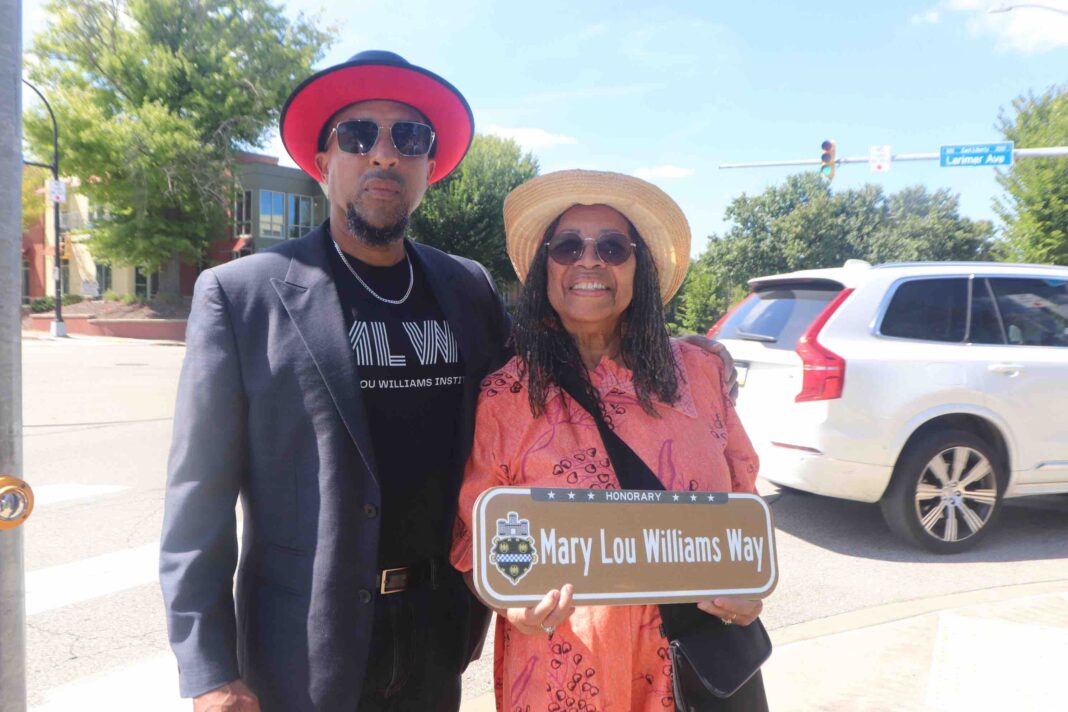


DR. GERALD FERGUSON AND BOBBIE FERGUSON WITH THE SIGN THAT READS, “MARY LOU WILLIAMS WAY.” (PHOTO BY ROB TAYLOR JR.)
Mary Lou Williams’ family, supporters celebrate the Sept. 11 event
At the corner of East Liberty Blvd. and Larimer Ave. on the East Liberty/Larimer border, there is a PRT bus stop. It’s used quite a bit by those, old and young.
The older population will look at the bus stop sign and see right above it, “Mary Lou Williams Way.” They probably know who she was. But the younger population at the bus stop? Probably not.
All the reason why it was important to immortalize Mary Lou Williams with a street renaming at that intersection.
“Mary Lou Williams was raised in this community as a young child, and she was able to do some great things being raised in this community,” said Dr. Gerald Ferguson, Williams’ great nephew. “I would hope that young people, when they see (the sign), they can say, ‘I can come from this same area and I can do great things on a worldly level.'”
Dr. Ferguson added that he wants the youth to “be inspired” by Mary Lou Williams.
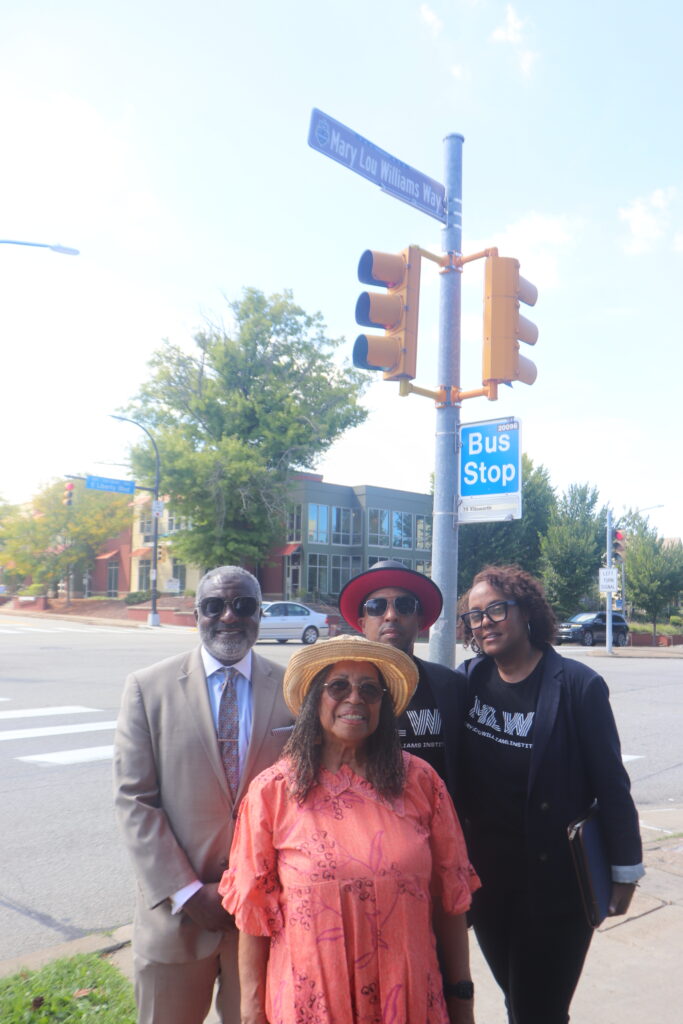
CELEBRATING “MARY LOU WILLIAMS WAY” — CITY COUNCILMAN KHARI MOSLEY, BOBBIE FERGUSON (FRONT), DR. GERALD FERGUSON (BLACK/RED HAT), AND JEANNINE FERGUSON. “MARY LOU WILLIAMS WAY” IS AT THE CORNER OF EAST LIBERTY BLVD. AND LARIMER AVE. (PHOTO BY ROB TAYLOR JR.)
On Friday, Sept. 11, 2026, about 100 people stood near the corner of East Liberty Blvd. and Larimer Ave. to celebrate the occasion of Williams having a street named after her.
Williams is one of the most important figures in the history of the jazz music genre. Born on May 8, 1910, in Atlanta, her family moved to Pittsburgh at a young age and settled in the East Liberty area. Folklore says that Williams was playing the piano as early as 2 years old. She had a nickname as the years went on: “The Little Piano Girl of East Liberty.”
By age 12, she was traveling while performing. Eventually, she found herself in places like Kansas City, playing ragtime, boogie-woogie and blues, along with popular and classical styles. Williams played a vital role in the legendary Kansas City jazz scene, as she and her husband at the time, John Williams, moved there in the late 1920s.
There is a street called “Mary Lou Williams Lane” in Kansas City in her honor.
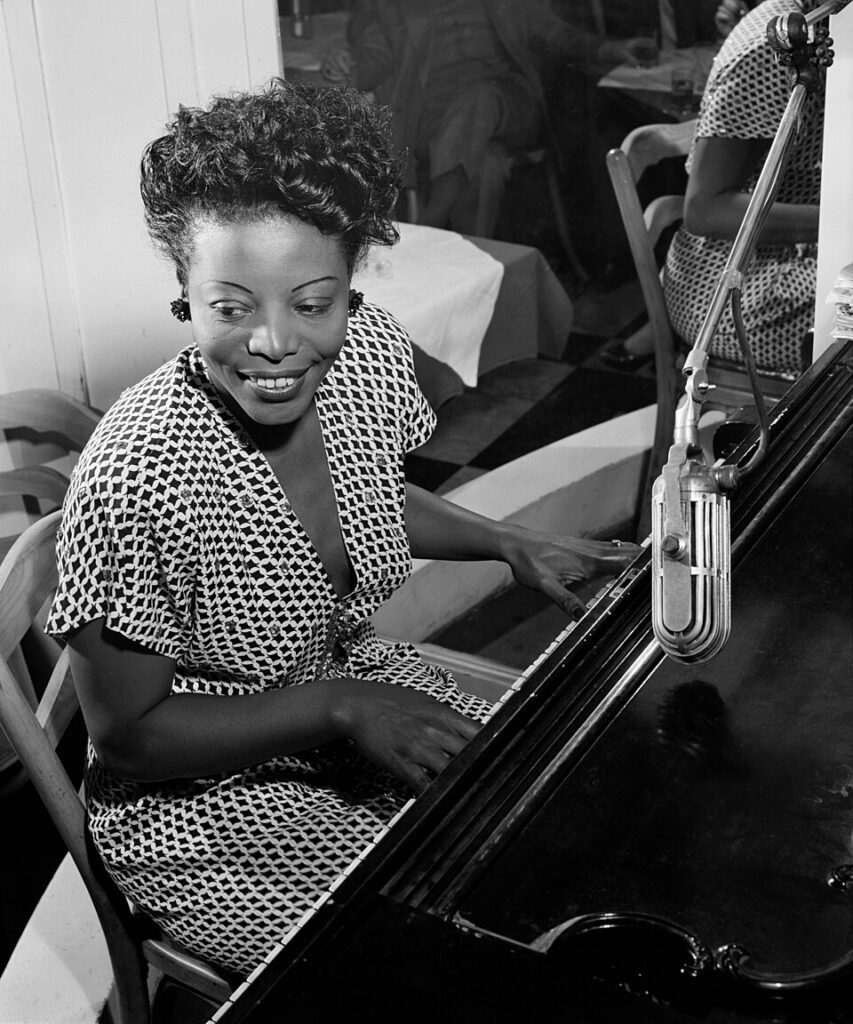
Williams, also known as the “First Lady of Jazz,” was an iconic jazz pianist, arranger and composer who worked with the greats—Duke Ellington, Benny Goodman, Dizzy Gillespie, and more. She mentored the likes of Miles Davis and Thelonious Monk.
Williams, a swing and bepop icon, also had another nickname: “The Lady Who Swings the Band.”
Later in life, Williams recorded “The History of Jazz,” a mixed album of music and speech intended to educate listeners about the evolution of jazz, according to her biography in the National Women’s History Museum. The biography also said Williams distributed the “Tree of Jazz,” an illustration that depicted the history of African American music from contemporary swing and bebop back to antebellum spirituals.
In 1977, Williams was named an artist-in-residence at Duke University, leading the jazz orchestra and teaching jazz history. On May 28, 1981, Williams died at her home in Durham, N.C. She was 71.
A year before she passed, Williams returned to Kansas City to receive an honorary degree from Rockhurst College.
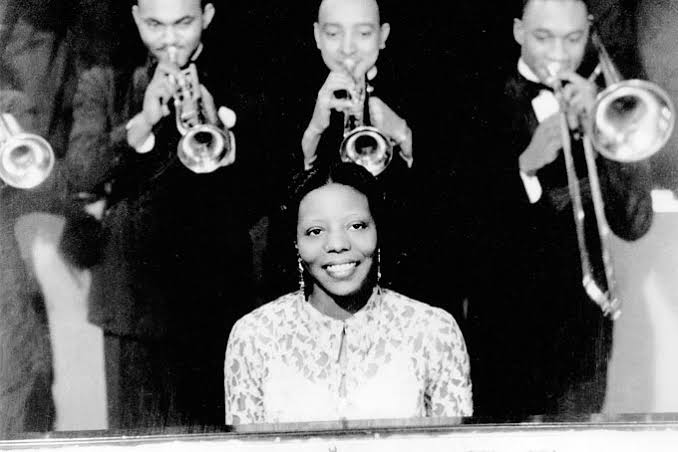
From Kansas City to New York City, there was an ode to the late Mary Lou Williams. In December 2025, a branch of the New York City Public Library called the Schomburg Center honored Williams as part of its 100th Centennial celebration. Several of Williams’ works were performed by pianist Camila Cortina Bello.
It had Dr. Ferguson thinking: What was being done to properly honor Mary Lou Williams in Pittsburgh? Dr. Ferguson’s mother, Bobbie Ferguson, is the niece of Williams. Together, they got the ball rolling on trying to get a street renamed for their beloved family member who contributed so much to the sound of jazz.
It all culminated with City Councilman Khari Mosley and his staff putting the final stamps on an event that has cemented Mary Lou Williams’ legacy in Pittsburgh forever.
“Today, we are not just renaming a street,” Councilman Mosley said at the Sept. 11 event. “We are solidifying a legacy that all who call Pittsburgh home should be proud of. Every time someone drives or walks on this corridor, they will recall a true icon, Mary Lou Williams. She wasn’t simply a jazz musician. She was an innovator, visionary and pioneer who impacted 20th-century music like few did. A child prodigy who eventually composed and arranged with some of the greatest musicians in the history of the world.”
Jazz aficionado Dr. Nelson Harrison, himself a composer and musician who’s widely respected across the country, told the story of a local jazz group called the Four Strings. The group recorded professionally only four songs, in 1947. That recording session was sponsored by none other than Mary Lou Williams.
“She was a great humanitarian who sacrificed her own life and her own livelihood to help those who were less fortunate,” Dr. Harrison told the assembled crowd, Sept. 11. “They asked her and she did that constantly because it was a spiritual practice to her.”
Currently, there is a Mary Lou Williams Foundation and a Mary Lou Williams Institute; the latter was founded by her niece, Bobbie Ferguson. Both are intended to keep the iconic musical prodigy’s works and influences alive for present and future generations.
Dr. Ferguson, Williams’ great nephew, told the Courier that in May 2027, the Mary Lou Williams Institute aims to have a weekend full of events to culminate what would have been Williams’ 117th birthday. Plans are in the works to have an event at Hotel Indigo in East Liberty, a play at the Alumni Theater in Larimer, a social gathering at Lit Cigar Lounge in East Liberty, all culminating with a daylong event along Larimer Avenue featuring a free concert, discussion and networking with the community.
“Today is special because Aunt Mary referred to Pittsburgh, the Steel City, as home,” Bobbie Ferguson told the crowd. “To have her remembered with her name on a street in an area where she was raised and was called ‘The Little Piano Girl of East Liberty’ is a very special honor to her. Hopefully this addition of her name to a community where her family has remained serves as an inspiration to all who pass by and to future generations, that no matter what the challenges are or what they face, with hard work, faith, the desire to achieve and the support of those who care, you can reach your pot of gold at the end of the rainbow.”