

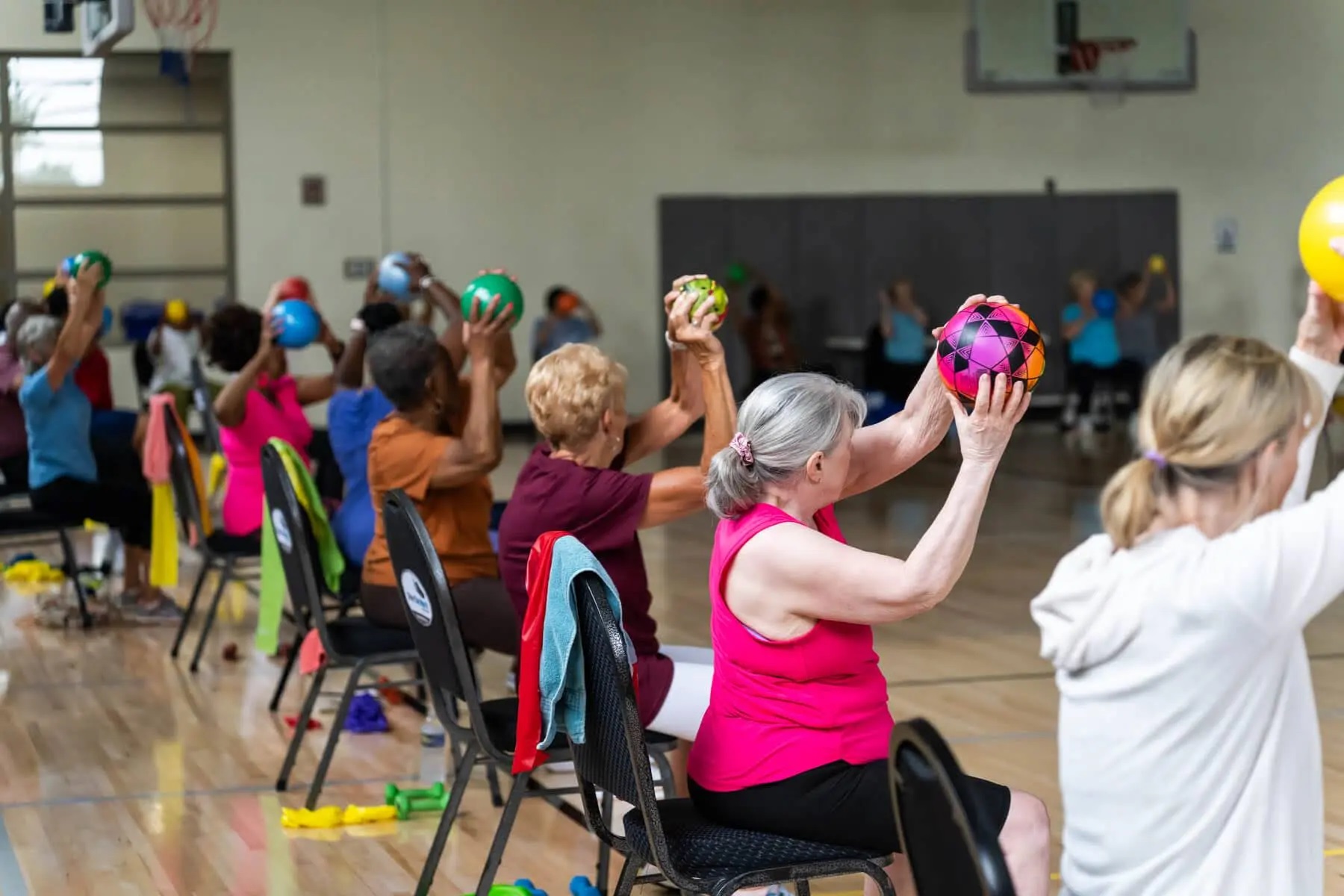

Seniors and adults take a “rhythmic movement with chair” class at the Kingsley Association in East Liberty on June 14, 2024. (Jess Daninhirsch/PublicSource)
Explore dance, biking, pickleball and community resources to enhance your golden years.
“PublicSource is an independent nonprofit newsroom serving the Pittsburgh region. Sign up for our free newsletters.”
She’s 74 and likes to hit the bike trails.
They both want to try pickleball, but it’s been too difficult to get it on their busy schedules.
Bruce Meyer travels over an hour from Greensburg just to dance in Allegheny County. He sometimes runs into his acquaintance Patty Sedlak, a Pittsburgh resident, who is one of some 240,000 adults ages 65 and over in Allegheny County, home to the second largest concentration of seniors in the U.S. after Palm Beach County in Florida.
Seniors face a number of challenges as they age, and there’s a tendency to only focus on the most acute.
Shadyside resident Dr. Alefiyah Mesiwala, a preventive medicine physician and former chief medical officer at Humana Military, said finding ways for older adults to stay active and engaged with their communities should be a priority in Allegheny County.
“Research demonstrates that in communities where people live the longest, the key to healthy aging is eating well, regular physical activity, a sense of purpose and, most importantly, a strong sense of community and social connectedness,” she said.
Resources from government agencies like the Area Agency on Aging and the county Department of Human Services as well as area nonprofits like Age-Friendly Greater Pittsburgh provide residents a wide range of choices when considering how to live and find support through their later years.
“Do what you enjoy!” recommends Jessica Neiss, a physical therapist and wellness center owner with 20 years in practice, whose work focuses on strength training for older adults. “Keep moving to keep doing what you love.”
PublicSource talked to some of the area’s older residents, reviewed a myriad of resources and compiled key ways, with specific suggestions, to help you or others explore paths to healthy aging.
Move it
Let’s dance
Meyer, once a math high school teacher and now a computer software consultant, waded into dance culture after breaking an ankle playing basketball 20 years ago. He decided dance was safer and now believes it keeps him healthy.
When we caught up with him, Meyer had already been to two dances that week, estimating six hours on his feet, and was gearing up for another that evening.

Research corroborates the idea that dancing is good for you. It was the only physical activity among many studied that was found to lower the risk of dementia, per an extensive longitudinal study published in the New England Journal of Medicine.
There is a dance to choose from every Saturday night and almost every other night of the week somewhere in the area — from Motown Monday to Ballroom Thursday to swing, Zumba, Argentine tango, South American dance and everything in between.
Meyer says the dance floor draws more women than men and most participants are 45-year-olds and up. On some nights, like at a dance called the Tiffany Club, Meyer’s 77 years bring down the average age. One regular, he says, is 96.
At some dances, you can find food and beverage; some have live music; and many offer a lesson beforehand and a pause for social mixing. You can arrive as a single and match to someone or come with a dance companion in tow. Meyer turns up to the dances alone or pairs with a dance buddy, attending with his wife’s blessing. She is in a nursing home, requiring 24-hour care.
By now a skilled lead and regularly sought out as a dance partner, Meyer carries a business card to break the ice and to help coordinate carpools later. It quotes one of his regular dance partners: “Bruce, you’re a good dancer. You’re a good lead and you’re not (too) creepy.”

If you’d like to join the fun and find a dance that works for you:
- The Cranberry Ballroom coordinates monthly dances.
- Each Thursday, social dancing starts at 7 p.m. and runs until about 9:30 p.m. in Squirrel Hill’s Wightman Ballroom, on the third floor of the Wightman School Community Building. Call 724-351-0219 for more information or check the Cranberry Ballroom calendar for updates.
- The Steel City Boogie Club calls itself Pittsburgh’s first dance club.
- And the Pittsburgh West Coast Swing Group shuffles on Tuesday evenings from 7 to 9:30 p.m. in Bellevue.
Bike, hike or pickleball it
Sedlak, who lives in Greenfield, is also a regular on the dance circuit and appreciates it as a form of cardio and as a way to socialize, but she also enjoys biking for many of the same reasons.
Bike Pittsburgh is a great first stop to get the lay of the land, offering a recreational biking resource guide. There you can find a group to join, not unlike Easy Riders, a senior bicycling group in Western Pennsylvania.
Pittsburgh’s BikeShare Program offers an affordable way to start exploring local trails and they have a selection of e-assist bikes in the program.
If you have a physical limitation, you can still get out on the trails thanks to Joy Riders Pittsburgh and the Veterans Leadership Program. Just request a ride on their wheelchair bike assisted by specially trained support persons.
Not interested in biking but want to get outdoors? Venture Outdoors organizes classes and events across a range of different activities, from walking and hiking to paddling, specifically tailored for ages 50-plus.
Another great way to accrue the physical or mental benefits of being outside is through gardening. If you’d like to garden with others, a compendium of community gardens for the area can be found with Grow Pittsburgh.
If you can fit it in your schedule, find a place to learn and play pickleball in the Greater Pittsburgh area through Pittsburgh Pickleball, the Allegheny County website or Visit Pittsburgh. And for all-season pickleball, the Pickleball Warehouse in Homewood is expected to open this month with 16 courts, coaching and lessons.
Connect and gather

Virtually
Randi Vega, community engagement manager for Age-Friendly Greater Pittsburgh, said she believes Allegheny County offers a hospitable environment for older adults, but stressed activities and events have to feel safe for seniors to want to engage. And the infrastructure has to support their needs, including accommodations for people with disabilities.
Local data shows a meaningful percentage of older adults, 74,000 people 65 or older, self-identify as having a disability — the majority, an ambulatory one.
Vega facilitates online gatherings of about five to seven people at a time, where, she says, “We are just friends. We chat together and talk about whatever’s going on in our lives or things that we’re interested in, or sometimes we have a topic that we get onto like gardening or something like that. But, generally speaking, it’s sort of free flowing.”
To join the biweekly Coffee Connect at 10 a.m. Thursdays, participants must register for the Virtual Senior Academy of the Jewish Community Center and then sign up for the Coffee Connect program. If you have any problems registering, contact Vega.
In person
Seniors make up the biggest share of visitors to the Kingsley Association, which largely serves the east side of Pittsburgh (East Liberty, Larimer, Lincoln-Lemington), said its health and wellness director, Nia Howze. Kingsley hosts many members of SilverSneakers, an insurance program that helps defray costs to a range of recreational and fitness activities.
While their classes focus on physical activities, Howze and her colleagues see participants come early and stay late or go out to lunch together as they form friendships and socialize. A favorite class is a dance workout with “great energy,” Howze said.
The rhythmic movement class at the Kingsley Association takes place Mondays and Wednesdays at 12:45 p.m. and Fridays at 12 p.m. Check their program schedule for more class offerings.

Community centers are spread throughout the county. Search the lists at Allegheny County Senior Centers or the City of Pittsburgh Healthy Active Living Centers to find one near you.
Older adults have stories to tell. If a crowd isn’t your jam, grab a friend to have a conversation together for posterity and earn a spot in the National Archives through StoryCorps Mobile. StoryCorps occasionally visits Pittsburgh, but recording is also available remotely.
You can consider keeping another senior company by becoming a Senior Companion.
Prefer time with a non-human friend? Adopting a pet into your home through Senior Paws for Seniors may be a (furry) way to go.
Work and learn
Vega wants people to know that “employment and volunteerism is an important kind of activity that older adults are involved in these days, particularly since adults are maybe healthier than in years past.”
Within Allegheny County, local data shows that labor force participation has been increasing across all age levels for older workers, but the population of 65-to 75-year-olds has seen the largest increase over the last decade.
Sedlak leveraged skills she picked up in retirement studying pastry baking into her dance interests. She now bakes for some of the dances, sometimes in exchange for free entry, and sometimes organizers buy her product outright. By request, Sedlak has also begun to sell her baked goods to interested dance goers.
Not sure what your passions are or want to add new skills to your repertoire before venturing into the workplace anew? There are many places that support learning in Allegheny County for older adults, including tuition-free options.
Osher Lifelong Learning Institutes offer classes in person or online with varying schedules throughout the year. Take a look at the University of Pittsburgh and Carnegie Mellon University Osher course catalogs.
You can also view the Community College of Allegheny County Community Training and Development programs.
Literacy Pittsburgh is another stop for help with skill development.
Make a change and live with intention
If you are wondering whether or not your neighborhood will be friendly and livable as you age, the Age-Friendly Community Index may be the tool for you. Allegheny County already has five Naturally Occurring Retirement Communities — places so populated with residents over 60 that they earn this distinction. Aleppo, Rosslyn Farms, Harmar, Sewickley Hills and Springdale may be places to consider.
There are also new intentional communities developing to age differently, such as the Rachel Carson EcoVillage currently under construction. A new housing development underway in Oakland is specifically designed for older LGBTQ+ residents in partnership with Presbyterian SeniorCare and Affirmative Investments.
Innovative statewide models are coming to Allegheny County through the Pennsylvania Department of Aging, such as SHARE [intergenerational shared housing] and ECHO [elder cottages]. Interested? You can learn more here.
Christine Graziano is a Pittsburgh-based freelance reporter and can be reached at studio.cgm@gmail.com.
This story was fact-checked by Cionna Sharpe.
This article first appeared on PublicSource and is republished here under a Creative Commons license.